The Blood of Brothers confronts a brutal question at the heart of civil war: how does the killing of neighbors, kin, and comrades become imaginable, legible, and justified? Fawwaz Traboulsi shifts the discussion away from military chronology toward the violence of intimacy, where memory, fear, identity, revenge, and political imagination intersect. Drawing on testimony, history, and culture, the book offers an account of civil war as a social, moral, and psychological experience rather than merely a sequence of battles or power balances.
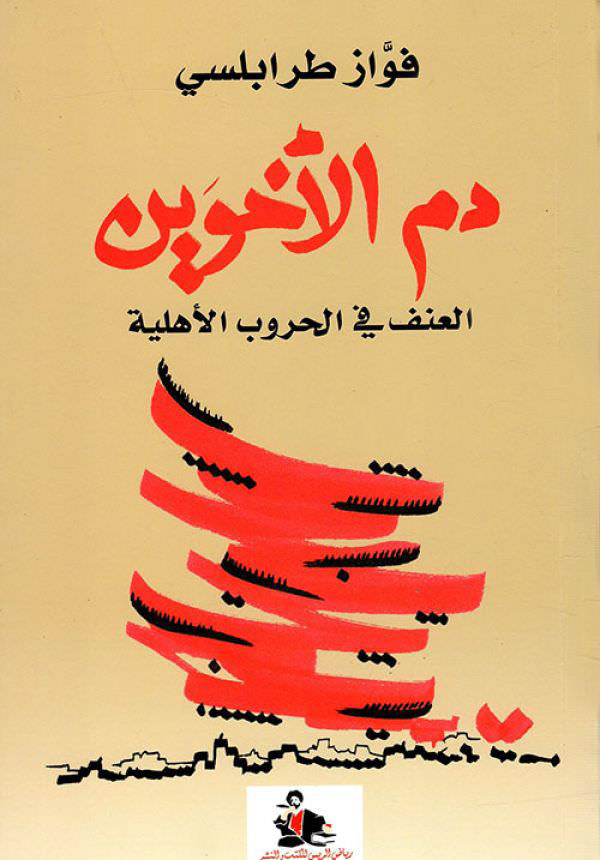
The Blood of Brothers: Violence in Civil Wars
دم الأخوين: العنف في الحروب الأهلية
Guide to the Book
This guide to the book presents the book's chapters and main lines of argument based on its actual contents; it is not a literal reproduction of the printed table of contents. Ten essays on the aesthetics and mechanics of violence in civil wars — drawing on the Lebanese civil war, art history, theatre, film, and poetry to explore how communities produce, ritualize, and remember collective violence. The title refers to the Dragon's Blood Tree (Dracaena cinnabari) of Socotra Island, whose red resin evokes the blood of Cain and Abel — the archetypal fratricide.
1 Violence in Civil Wars: Functions and Rituals
- Violence of the Masses — Saint Barbara's Day as carnival; the looting of Beirut's port as class reversal
- Tribal Violence
- In the Beginning Was the Mother — The mother figure driving men to kill; Marwan the Shia fighter
- Striking at Honour — Symbolic warfare through insults and verbal duels across battle lines
- Striking at Honour: Rape — Sexual violence in the Lebanese civil wars
- Desecrating and Purifying Sacred Territory — Checkpoints, identity cards, sectarian cleansing, the concept of the "stranger"
- Violence and the Sacred
- Beatification of Absent Leaders — Sacralization of Bashir Gemayel (as Christ) and Imam Musa al-Sadr (as Hidden Imam)
- The Weapon of Miracles — Apparitions of the Virgin Mary, patron saints in battle
- A "Cold War" Over a Miracle — The beatification of Saint Charbel in 1977 and its political instrumentalization
- The Sniper, or the Collective in Singular Form — Reducing the enemy to a singular essence; the sniper as modern tribal avenger
- Crime and Punishment: The Avenger Between Two Legal Orders — Joseph Saadeh, "the butcher of Ain el-Rummaneh"; René Girard's scapegoat mechanism; Albanian blood feuds via Ismail Kadare
- Secret Mechanisms
- Disposing of the Human Surplus — Palestinians as "surplus people"; the Sabra and Shatila massacre; emigration as violence; Russian roulette among fighters
- The Enemy Is Me — Internalization of the enemy; Walid Jumblatt's "the enemy is now inside each one of us"
The book's centrepiece: a comprehensive analysis of violence in the Lebanese civil war through the lens of Hannah Arendt's distinctions between power, force, and violence. Traboulsi dissects the rituals of collective killing — from the carnival-like looting of Beirut to checkpoint identity verification, the sacralization of militia leaders, the sniper as tribal avenger, and the mechanisms by which entire communities become "surplus" to be eliminated. A foundational text in the anthropology of Lebanese wartime violence.
2 Posters as Weapons
- Introduction to Zeina Maasri's study of political posters in the Lebanese civil war
- Posters as "symbolic spaces of political conflict"
- The theory of the "image-act" (Horst Bredekamp)
- Destruction and veneration of images — the relationship between images and violence
An essay on the visual culture of the Lebanese civil war, introducing Zeina Maasri's research on political posters as weapons in the conflict. Drawing on Horst Bredekamp's theory of the "image-act," Traboulsi analyses how posters functioned as symbolic battlefields — simultaneously icons to be venerated and targets to be destroyed.
3 On the Cathars, Evil, and What They Draw
- The Cathar heresy in 12th-century southern France
- Dualist theology: the problem of evil and the material world
- Iconoclasm and the representation of evil in art
A meditation on the Cathar heresy and its radical dualism — the belief that the material world is the creation of an evil god. Traboulsi uses the Cathar rejection of images and the body to explore the deeper relationship between theological dualism, iconoclasm, and the depiction of evil in Western art.
4 Käthe Kollwitz: Faces of Motherhood Against Tyranny and Death
- Kollwitz's life: loss of her son Peter in World War I
- The Weavers' Revolt series and the Peasants' War cycle
- Prints and sculptures on motherhood, grief, war, and sacrifice
- The memorial Mother and Dead Son in Berlin's Neue Wache
A study of the German artist Käthe Kollwitz — the anti-war mother who transformed personal grief into universal art. From the Weavers' Revolt engravings to the Pietà-like memorial in Berlin, Traboulsi reads Kollwitz's work as the definitive artistic statement on the cost of war borne by mothers — a theme that echoes through the Lebanese civil war's own culture of martyrdom and maternal sacrifice.
5 What Good Is the Feeling of Guilt?
- Culturalism as Grand Narrative — Critique of Bernard Lewis, Samuel Huntington; "culture of humiliation" vs. "culture of death" vs. "culture of resistance"
- The Culture of Guilt and the Culture of Shame — Critique of the Orientalist binary; Ashura as Shia collective guilt; Holocaust memory (Ruth Leys, Giorgio Agamben)
- David and Goliath: Role Reversal — The politicized David-Goliath narrative in the Israeli-Palestinian conflict; the Palestinian child with a slingshot as the new David
- David and Goliath: The Killer-Victim — Caravaggio's obsession with violence and beheading; his David and Goliath paintings as self-portraits embodying both killer and victim
- Picasso: Guernica-Beirut — Traboulsi's 1987 book; Picasso's technique of "distilling" killer and victim into one body
- What Good Is Guilt in Civil Wars? — Assad Sheftari's public repentance; the dialectic of memory and forgetting; Ernest Renan on nations; Mahmoud Darwish's Memory for Forgetfulness
A multi-layered essay on guilt, shame, and memory in the aftermath of civil wars. Traboulsi moves from a critique of culturalist explanations of violence (Lewis, Huntington) through the guilt/shame binary in Orientalist thought, to Caravaggio's paintings of David and Goliath as images of the killer-victim duality. The essay culminates in the question of post-war Lebanon: can guilt be productive? Through Assad Sheftari's rare public repentance and Mahmoud Darwish's Memory for Forgetfulness, Traboulsi argues that civil wars demand both remembering and forgetting — following Renan's insight that every nation is built on shared amnesia.
6 Heiner Müller and the Theatre of Aggression Against Reality
- The First Scene — Müller's childhood, his father's arrest by the Nazis, the formative trauma
- Life under two dictatorships: communism and capitalism
- Müller's debt to Brecht and comparison of himself to Goya
- Theatre as "aggression against reality"
On the East German playwright Heiner Müller, who lived under two dictatorships — Nazi Germany, then the GDR, then reunified capitalist Germany. Traboulsi reads Müller's theatre as a sustained "aggression against reality," tracing the line from Brecht through Müller's own radical fragmentation of dramatic form. The essay opens with the foundational trauma: the child watching his father arrested by the Nazis, a scene Müller returned to obsessively.
7 "The Perfect Circle": A Murdered Child and a Child Murderer
- Ademir Kenović's film on the siege of Sarajevo
- A man sheltering two orphaned children
- Daily rituals of survival under siege
- The full circle: violence that kills a child and turns a child into a killer
Analysis of Bosnian director Ademir Kenović's film The Perfect Circle (1997), set during the siege of Sarajevo. A man takes in two orphaned brothers; in the circle of violence, the child who was victim becomes perpetrator. Traboulsi draws parallels between the Sarajevo and Beirut sieges — the daily rituals of survival, the transformation of children by war, and the terrible symmetry of the "perfect circle" of violence.
8 Your Sparrow Is Hunchbacked, O Muhammad!
- Muhammad al-Maghut's The Hunchback Sparrow
- Poverty, class conflict, the rural-urban divide in Syrian society
- Violence against the weak in al-Maghut's poetry and theatre
A literary essay on the Syrian poet and playwright Muhammad al-Maghut and his masterpiece The Hunchback Sparrow. Traboulsi reads al-Maghut's work as a sustained cry against the violence inflicted on the poor and the powerless — the rural migrant in the city, the prisoner, the hungry child. Al-Maghut's "hunchbacked sparrow" becomes a figure for all those deformed by the violence of class and state.
9 "Guernica" for All Arab Wars
- Return to Guernica — The 1937 bombing, Picasso's response, Franco's denial, Goering's Nuremberg confession
- The mural's journey from MoMA back to Spain
- Contemporary artists responding to Guernica in the context of Arab wars (Iraq, Syria, Gaza, Lebanon)
A sweeping essay tracing the afterlife of Picasso's Guernica across Arab wars. From the original 1937 bombing through Franco's denial and Goering's confession at Nuremberg, to the mural's return to democratic Spain, Traboulsi charts how each new war — Iraq, Syria, Gaza, Lebanon — generates its own artistic response to the archetype of aerial terror that Picasso captured. Guernica becomes not one painting but a template for representing the bombing of civilians.
10 Excavations of the Sky — Excavations of the Earth
- The Syrian pavilion at the 2015 Venice Architecture Biennale
- First Ottoman military airplane landing in Damascus (1914)
- British RAF bombing of Iraq's 1920 revolt
- French bombing of Damascus during the 1925 Syrian revolt
- Total war and the targeting of civilians, culminating in Hiroshima
- The drone — video-game interface, targeted assassinations
- The barrel bomb — invented by Syrian regime general Jamil al-Hassan
- Drilling a well in Daraa — "excavations of the earth" as answer to "excavations of the sky"
The book's final and most historically grounded essay, beginning at the Syrian pavilion at the 2015 Venice Architecture Biennale and tracing the entire history of aerial warfare against civilians in the Arab world: from the first Ottoman plane over Damascus in 1914, through the British RAF bombing of Iraq's 1920 revolt and the French bombardment of Damascus in 1925, to the drone and the barrel bomb. The essay ends where it began — at Venice, where the Syrian team's response to the "excavations of the sky" was to drill a well in Daraa province: excavations of the earth, life against death.
Back Matter
- Bibliography of the author's works
- Index of names and places