From Other Angles gathers journalistic and reflective texts written in direct contact with events, yet their arrangement in a book gives them a second life beyond immediate circumstance. Fawwaz Traboulsi moves between politics, culture, the city, and memory, proposing the act of reading “from other angles” as a refusal of quick explanation and ready-made certainty. The book becomes an exercise in shifting perspective itself, not to escape reality but to see what frontal and habitual vision leaves hidden.
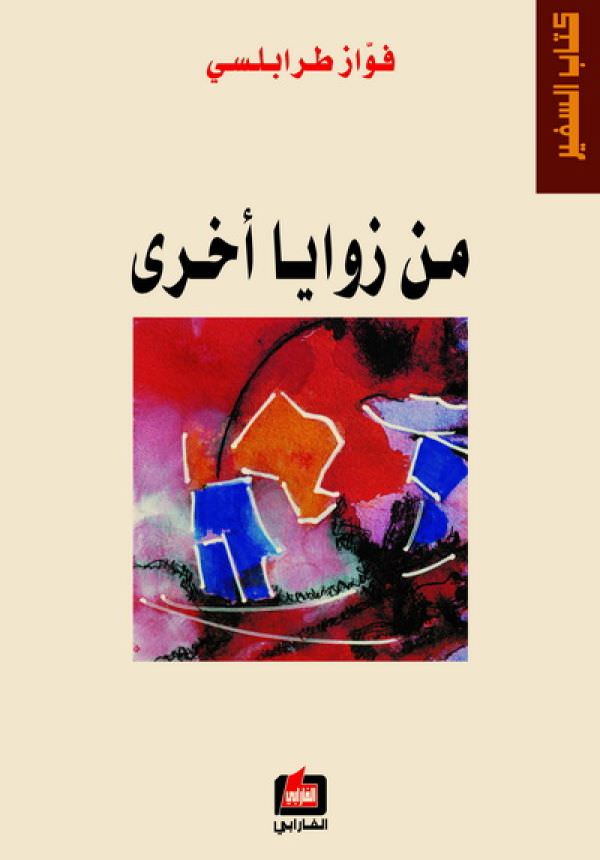
From Other Angles
من زوايا أخرى
Guide to the Book
This guide to the book presents the book's chapters and main lines of argument based on its actual contents; it is not a literal reproduction of the printed table of contents. Published on the 35th anniversary of the daily As-Safir, this book collects Traboulsi's weekly column from May 2006 to February 2008 — a period that encompassed the 2006 Israeli war on Lebanon, the deepening Lebanese political crisis between the March 14 and March 8 camps, the Iraqi civil war and the execution of Saddam Hussein, the Hamas takeover of Gaza, and the global reverberations of the "war on terror." The columns do not claim comprehensiveness; they seek, as Traboulsi writes in the preface, "to cast a glance from different angles — sometimes new, sometimes confrontational — on the most prominent events and developments in Lebanon, the Arab region, and the world."
Lebanon: The Political Crisis (2006–2008)
- In Defence of the Beirut-Damascus Declaration
- Lebanon of National Unity: Between "Consensus" and "Majority"
- Shelters Needed for the Front-Line Villages!
- A System Running on the Power of Obstruction
- The Crisis between Politics and Economics
- Toward a Lebanese-Syrian Historic Settlement: Who Dares?
- The "Ta'if" of Those Who Have No "Sect": The Wound, Not the Arrow!
- Lebanon in the Winds of Peace
These columns address Lebanon's post-2005 political paralysis — the standoff between the March 14 coalition (Future Movement, Lebanese Forces, Kataeb) and the March 8 opposition (Hezbollah, Free Patriotic Movement, Amal). Traboulsi analyses the constitutional crisis with characteristic precision, dissecting the "blocking third" mechanism, the dual legitimacy of parliamentary majority and consensual democracy, and the structural impossibility of a system where every actor can obstruct but none can govern. His column on the Ta'if Agreement argues that all constitutional debates — whether for revision or defence — revolve around a single face of the accord (power-sharing between sects) while systematically ignoring its other face: the constitutional commitment to abolish sectarianism. The columns on Lebanese-Syrian relations — including his defence of the Beirut-Damascus Declaration, which he co-signed — are among the most politically courageous in the collection.
The 2006 War and Its Aftermath
- One Year after the Israeli Aggression: No Accountability, No Review, No Follow-Up!
- 11 September and Arab Denial
- "The Conspiracy" — Who Executes It?
Traboulsi's columns on the 2006 Israeli war on Lebanon combine military analysis with political critique. He documents how Israel emerged as the primary beneficiary of the war — the Winograd Commission led to the resignation of the chief of staff and defence minister, a strategic review of the army, and a rehabilitation of ground forces. On the Lebanese side: no accountability, no review, no follow-up. The column on conspiracy theories is one of the collection's most intellectually ambitious — using the Oedipus myth to analyse how Arab conspiracy thinking functions as a mechanism for evading self-criticism, blaming external enemies for domestic failures, and reproducing political paralysis.
Iraq: Occupation, Civil War, and the Execution of Saddam
- An Attempted Assassination of Election by Acclamation!
- Bush and Iraq, or the Reversed "Cowboy" Story
- The Execution of Judgements in the Execution of Saddam
The Iraq columns demonstrate Traboulsi's ability to hold multiple critiques simultaneously. He condemns the American occupation while refusing to romanticise either the Saddam regime or the sectarian militias that replaced it. His analysis of the execution of Saddam Hussein is devastating: a trial that prosecuted two crimes (Dujail and Anfal) while ignoring three wars, the destruction of the Iraqi state, and policies that killed more Iraqis than the occupation itself. The column on Bush and Iraq — structured as a comparison between "the project" and "the results" — is a masterclass in political satire, documenting point by point how every American objective in Iraq produced its exact opposite.
Palestine: Gaza, Hamas, and the Peace Process
- "The Conspiracy" — Who Executes It?
- Welcoming Obama: An Invitation to Outbid
- The Holocaust of "Security"
Traboulsi's Palestine columns refuse the binary between Hamas and Fatah, analysing the Hamas takeover of Gaza as two simultaneous coups — one by Hamas against the national unity government, another by the Palestinian Authority (backed by the US and EU) against democratic election results. His column welcoming Obama's presidency is characteristically contrarian: instead of celebrating, he calls on Arab states to "outbid" — to declare publicly that there is no Israeli partner for peace, suspend all normalisation agreements, and use whatever leverage they possess. The columns on Gaza during the 2008-2009 Israeli assault are among the most politically charged in the collection, calling for an Arab popular strike and arguing that the Arab-Israeli conflict has been systematically hollowed out of its national liberation content.
Arab Politics and International Affairs
- "Moderation" — the Other Name for Submission
- Yemen: the Presidential Elections
- The Lebanese-Syrian Crisis
- Democracy and Resistance
These columns range across the Arab world and beyond, united by Traboulsi's insistence that domestic authoritarianism and external dependence are structurally connected. His critique of Arab "moderation" — the American-approved label for regimes that submit to US and Israeli demands — is withering: "moderation" means, in practice, that American imperial democracy will never produce democracy, "not now and not ever." The Yemen column — in which Traboulsi admits his own misjudgement about Ali Abdullah Saleh's announced resignation — is a rare moment of political self-criticism. The columns on Lebanese-Syrian relations call for a historic settlement based on mutual recognition, diplomatic exchange, and border demarcation — proposals that were politically explosive at the time.