This book dismantles the thought of Michel Chiha not as an individual opinion, but as a central knot in the making of modern Lebanese ideology. Fawwaz Traboulsi reads economic liberalism, confessional representation, the idea of “balance,” and the relation between money and politics in order to show how this discourse shaped Lebanon’s image of itself and the ruling classes’ image of society. Chiha thus becomes an entry into the critique of an entire system of privilege and assumption, not merely a figure in intellectual history.
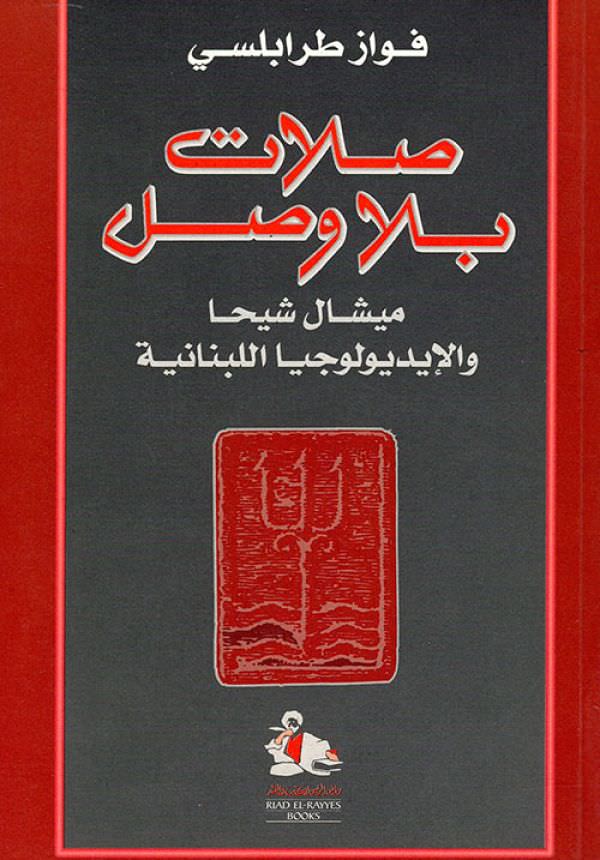
Connections without Linkage: Michel Chiha and Lebanese Ideology
صلات بلا وصل: ميشال شيحا والإيديولوجيا اللبنانية
Guide to the Book
This guide to the book presents the book's chapters and main lines of argument based on its actual contents; it is not a literal reproduction of the printed table of contents. Dedicated to the filmmaker Maroun Baghdadi, this book is a systematic critical study of Michel Chiha — banker, journalist, constitutional drafter, and the single most influential ideologue of the Lebanese Republic. Traboulsi reconstructs Chiha's thought not as philosophy but as ideology in the precise sense: a coherent system of ideas that serves specific class interests while presenting itself as universal truth. The book's title — "Connections without Linkage" — comes from Chiha's own phrase and captures the central paradox of his vision: a Lebanon that connects East and West, Mountain and Sea, sect and sect, without ever truly linking them into a unified society.
1 The Banker, the Journalist, the Ideologue
- The Chiha-Pharaon dynasty
- Banker: Banque Pharaon et Chiha
- Journalist: Le Jour and the editorial voice
- Constitutional drafter: the 1926 Constitution
- The organic intellectual of the commercial-financial bourgeoisie
The opening chapter reconstructs Michel Chiha's triple identity: a Chaldean Catholic banker from a powerful Beirut family married into the Pharaon dynasty; the founder and editorial voice of the French-language daily Le Jour; and the principal architect of the 1926 Lebanese Constitution. Traboulsi shows how these three roles were inseparable — Chiha's journalism served his banking interests, his constitutional drafting institutionalised his class's political vision, and his ideology naturalised the economic order from which his family profited. The chapter establishes that Chiha was not a detached intellectual but the organic intellectual of Beirut's commercial-financial bourgeoisie — the man who gave that class its self-understanding, its political programme, and its claim to represent Lebanon as a whole.
2 "Geographic Determinism" or the Split Personality of Lebanon
- The Mountain and the Sea: Chiha's founding duality
- Mountain = spirituality, community, isolation
- Sea = commerce, cosmopolitanism, openness
- Geography as theology: naturalising class domination
- The prescriptive function of "descriptive" geography
Traboulsi dissects what he calls Chiha's "geographic determinism" — the foundational claim that Lebanon's character is dictated by its geography: the Mountain produces spirituality, community, and isolation; the Sea produces commerce, cosmopolitanism, and openness. This duality becomes the master key to Chiha's entire system: every contradiction in Lebanese society is explained as a geographic given rather than a political choice. The chapter shows how this geographic theology performs a precise ideological function: it naturalises the division between a commercial coastal elite and a rural mountain hinterland, presenting class domination as landscape. Traboulsi demonstrates that Chiha's "geography" is not descriptive but prescriptive — it tells Lebanon what it must be rather than what it is.
3 On a Liberalism without Banks
- The external role first: Lebanon as commerce and services
- The superior commerce: from necessity to civilisation
- The war against industry and industrialisation
- From agriculture to tourism and real estate speculation
- Justifying economic dependency and foreign investment
- The Naim Amiouni counter-argument
- The dominance of the import-export bourgeoisie
This chapter analyses Chiha's economic thought — a radical laissez-faire liberalism that opposed all state intervention in the economy, rejected progressive taxation, fought industrialisation, and defended Lebanon's vocation as a commercial and financial intermediary. Traboulsi shows how Chiha systematically argued against any economic policy that might threaten the interests of the import-export bourgeoisie: protectionist tariffs, state planning, industrial development, labour legislation. The chapter's title is ironic: Chiha's "liberalism" had no theoretical depth — no engagement with Smith, Ricardo, or Mill — but it served its purpose perfectly as the ideology of a specific fraction of capital. Traboulsi reconstructs the counter-argument of Naim Amiouni, who in a 1946 lecture at the American University demonstrated that Lebanon's productive sectors were being deliberately sacrificed to the commercial-financial elite's interests, and that the country's workforce was overwhelmingly composed of wage workers and peasants — not the "nation of merchants" that Chiha proclaimed.
4 "The Party of Importers" in Lebanese-Syrian Economic Relations
- From disagreement on political unity to disagreement on economic unity
- The creation of Greater Lebanon and the customs union
- The independence era: what the Mandate united, independence divides
- The customs revenue dispute
- Industry between protection and subjugation
- The currency dispute
- The Husni al-Za'im coup overturns the equations
- The economic rupture of 1950
This chapter examines how Chiha's economic ideology shaped Lebanese-Syrian relations — specifically, how the Beirut commercial bourgeoisie (which Kamal Jumblatt called "the party of importers") fought to maintain Lebanon's role as the gateway for imports into Syria while resisting any economic integration that might benefit Syrian industry or Lebanese workers. Traboulsi reconstructs the customs union negotiations, the currency disputes, and the trade wars between the two countries, showing how Chiha consistently advocated for policies that served Beirut's commercial monopoly at the expense of both Syrian and Lebanese productive sectors. The chapter demonstrates that the economic separation of Lebanon from Syria — often presented as a natural consequence of Lebanese identity — was in fact a political project driven by the material interests of the import-export bourgeoisie.
5 Freedom against Equality: The Difficulties of Reconciling Money and Morals
- The external source of poverty
- Denying the existence of large fortunes
- Denying exploitation
- Natural inequality and the impossibility of social justice
- The budget as deposit: Chiha's fiscal theory
- "Social equality exists only in paradise"
- Social Darwinism: freedom + inequality = survival of the fittest
This is the book's most devastating chapter — a systematic exposure of Chiha's social thought. Traboulsi shows how Chiha denied the existence of poverty in Lebanon (attributing it to "external sources" — immigrants from the annexed regions); denied the existence of large fortunes (claiming Lebanese businessmen "barely make a living"); denied the existence of exploitation (arguing that since Lebanon had no industry, it could have no exploitation); and opposed all redistributive policies, progressive taxation, and social legislation. The chapter traces Chiha's intellectual genealogy to Social Darwinism — the doctrine that inequality is natural, freedom and equality are incompatible, and any attempt to reduce social disparities rewards "the weakest and worst." Traboulsi quotes Chiha's extraordinary claim that "social equality exists only in paradise" — a theological closure of the social question that reveals the ideological function of religion in his system.
6 On Domestic Politics: Entityism, Sectarianism, Traditionalism
- The entity, not independence
- Chiha and the National Pact
- Sectarianism as justification for Lebanon's existence
- "Lebanon is the country of participatory sectarian minorities"
- Minorities — relative to what and to whom?
- Manipulating the demographic question
- The "participatory sectarian minorities" — participating in what?
- Fear and commercial partnership
- The market as coexistence
- Traditionalism: the defence of feudal leadership
- The zu'ama (traditional leaders) as natural order
- Chiha's "philosophy of sectarianism in Lebanon"
This is the book's longest and most analytically complex chapter. Traboulsi examines Chiha's domestic political thought through three interlocking concepts: entityism (the doctrine that Lebanon's existence as a separate entity takes priority over its independence); sectarianism (elevated by Chiha from a political arrangement to a cosmic vision — "Lebanon is the country of participatory sectarian minorities"); and traditionalism (the defence of feudal notables, hereditary leadership, and patriarchal authority as the natural order of Lebanese politics). The chapter's most important contribution is its analysis of how Chiha reframed the demographic problem created by Greater Lebanon — the loss of the Christian majority — not through democratic reform but through the formula of "participatory sectarian minorities" united by fear of the external Sunni majority and by the commercial partnership of the marketplace. The concept rests on two pillars: fear of the external "majority" (which unites all sects as "minorities") and the economic interest of commercial partnership (which binds them through the market).
7 The Miracle or "The Radar"
- Arnold Toynbee's lecture at the Cénacle Libanais
- Ghassan Tueni and the miracle discourse in An-Nahar
- The miracle as omnipresent explanation
- Uniqueness as self-referential tautology
- The "radar": translating miracle into secular language
- Father Lebret's testimony
A short but brilliant chapter that deconstructs the concept of the "Lebanese miracle" — the idea that Lebanon's prosperity, stability, and coexistence are miraculous, defying rational explanation. Traboulsi traces the genealogy of this discourse from Arnold Toynbee's lecture at the Cénacle Libanais through Ghassan Tueni's ecstatic editorials in An-Nahar. Traboulsi counts: in a 700-word editorial, Tueni uses the word "miracle" no fewer than 48 times — once every 15 words. The chapter reveals that the "miracle" is the ideological capstone of Chiha's entire system: when geographic determinism, liberalism, sectarianism, and traditionalism have done their work, what remains is explained by miracle. Translated into secular language, the "miracle" becomes a "radar" — a quasi-religious guidance system that steers the country without human intervention. The miracle is the ideology's confession that it cannot explain its own success.
8 "The Universal Nexus": Principles in Arab and International Politics
- The hierarchy of dangers: communism as supreme threat
- Anti-communism and complicity with fascism
- Chiha and Vichy, Pétain, Salazar, Franco
- Chiha and the Second World War
- The "principle of dependency" in foreign relations
- Exonerating colonialism
- Organising Lebanese dependency
- Mediterraneanism as civilisational vocation
This chapter examines Chiha's foreign policy thought — built on three principles: anti-communism as the supreme priority; "dependency" as a natural law requiring Lebanon's attachment to the dominant Western power; and Mediterraneanism as Lebanon's civilisational vocation. Traboulsi documents Chiha's extraordinary hostility to communism — which he considered a greater danger than death itself — his ambiguous relationship with fascism and Nazism (sympathy for Vichy, admiration for Pétain, enthusiasm for Salazar, equivocation about Franco), and his post-war rehabilitation of European colonialism as a civilising mission. The chapter reveals the deepest contradiction in Chiha's system: his insistence on Lebanon's independence coexisted with his equally insistent demand that Lebanon attach itself to the dominant Western power — making "independence" mean, in practice, the freedom to choose one's protector.
9 Palestine between Economics and Western Alliances
- Chiha: the most prolific Lebanese writer on Palestine
- The "identification of the two similars": Lebanon and the Jewish national home
- The "competition between the two similars": Israel as economic rival
- Contacts between "New Phoenicians" and Zionist agents
- Chiha's anti-Semitism: the conflation of Judaism, Zionism, and communism
- The economic argument against Zionism
This chapter — introduced by a quotation from Kamal Jumblatt calling Chiha "undoubtedly the most prolific Lebanese writer on the Palestinian question" — reconstructs Chiha's complex and shifting positions on Zionism and Israel. Traboulsi identifies two competing currents in Lebanese Christian thought: the "identification of the two similars" (Lebanon and the Jewish national home as twin minority refuges) championed by Bishop Mubarak, and the "competition between the two similars" (Israel as an economic and political rival) which was Chiha's own position. The chapter traces how Chiha opposed Zionism not from solidarity with the Palestinians but from fear that a Jewish state would compete with Lebanon's role as the region's commercial intermediary and financial haven.
10 Connections without Linkage: Near East or Mediterranean?
- "Near East" versus "Middle East": the naming contest
- The Baghdad Pact and the Cold War dilemma
- Nasserism destroys Mediterraneanism
- The Suez crisis of 1956
- Connections to everyone, linkage to no one
The title chapter examines how Chiha's vision of Lebanon as a "universal nexus" — connecting East and West — collapsed under the pressure of Cold War geopolitics. Chiha insisted on the designation "Near East" (a Mediterranean, culturally European region) against the Anglo-American "Middle East" (a strategic zone stretching from Pakistan to Egypt). But the Cold War forced Lebanon to choose between Western military alliances and Arab nationalism — precisely the choice Chiha's system was designed to avoid. The chapter traces how Chiha's Mediterraneanism was destroyed by the rise of Nasserism, the Baghdad Pact controversies, and the Suez crisis of 1956, leaving Lebanon's "universal nexus" with connections to everyone but linkage to no one — the book's governing metaphor for the structural impossibility of Chiha's vision.
11 The Swiss Model: Its Merits and Demerits
- The origins of "Lebanon, Switzerland of the East"
- What Lebanon admired in Switzerland
- What Lebanon lacked: industrial economy, peasant-soldier democracy, cantonal autonomy
- Banking secrecy: two treasure vaults compared
- Peasant revolution versus feudal preservation
- The comparison as indictment
The final chapter takes apart the most durable cliché in Lebanese political discourse: "Lebanon, the Switzerland of the East." Traboulsi traces the phrase to French colonial officials who promised Mount Lebanon's inhabitants that their mountains would become as prosperous as the Alps. He then conducts a devastating comparison between the two countries — showing that everything the Lebanese ideologues admired about Switzerland (neutrality, banking secrecy, cantonal autonomy, financial prosperity) rested on foundations that Lebanon lacked: an industrial economy, a peasant-soldier democratic tradition, genuine cantonal self-governance, and compulsory military service. Switzerland was founded by peasant revolts against feudal tyranny; Lebanon's confessional system was designed to preserve feudal authority. The comparison, pushed to its logical conclusion, becomes an indictment.
• Conclusion: Repeating Beginnings or a Present Open to the Future?
The conclusion asks whether Lebanon is condemned to repeat Chiha's founding vision — with its structural contradictions, its denial of class, its naturalisation of inequality, and its dependence on external protection — or whether it can break free into a genuinely new political imagination. Traboulsi argues that Chiha's ideology has proven remarkably resilient not because it was true but because it served the interests of the class that controls the economy, the banks, the media, and the political system. The postwar reconstruction under Rafik Hariri was, in many ways, a return to Chiha's model — updated for the age of globalisation but structurally identical. Breaking with Chiha requires not merely critiquing his ideas but transforming the material conditions that make them plausible.
Back Matter
- Notes
- Index of Names
- Index of Places