This book returns class analysis to the center of Lebanese politics against readings that reduce everything to sect or to the balance of external powers. Fawwaz Traboulsi traces the formation of social classes and their relation to the state, patronage, the economy, and political representation, showing how sectarian structures operate within a material social history rather than outside it. It remains an essential reference for any attempt to understand modern Lebanon as a society and a struggle over power, not as a closed communal riddle.
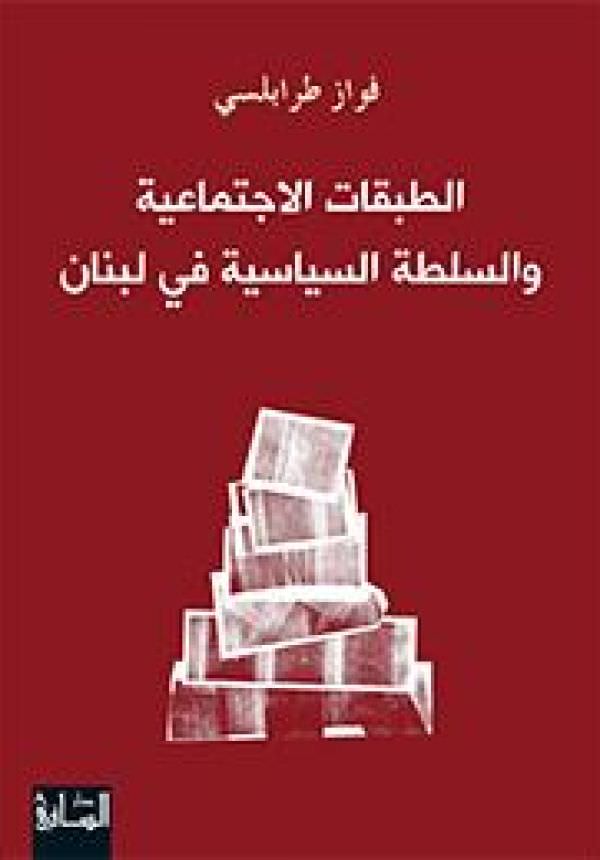
Social Classes and Political Power in Lebanon
الطبقات الاجتماعية والسلطة السياسية في لبنان
Guide to the Book
This guide to the book presents the book's chapters and main lines of argument based on its actual contents; it is not a literal reproduction of the printed table of contents. Dedicated to Hanna Batatu — the great historian of class in Iraq — this book is Traboulsi's most sustained intervention in political economy. It reintroduces class analysis into the study of Lebanese society at a moment when sectarian categories have almost entirely displaced it. The book argues that Lebanon's postwar political order cannot be understood without examining the oligarchic class structure that underlies and reproduces the confessional system: who owns what, who profits from whom, and how economic power converts into political authority.
1 Methodological Reference Points
- The thought of denial
- Neoliberal distortion in measuring social disparities
- On defining classes
- The sectarian and the class-based
- On unequal origins and uneven development
- Sects within the class structure
The opening chapter confronts head-on the ideological denial of class in Lebanese public discourse. Traboulsi shows how both Lebanese elites and international institutions — notably the World Bank — have systematically avoided class analysis: elites by insisting that Lebanon is "a country of sects, not classes," and the World Bank by replacing production-based measures of inequality with consumption-based metrics that obscure the real distribution of wealth. The chapter critiques the neoliberal methodology that measures poverty by individual daily expenditure rather than by income, wealth, or ownership of means of production — a method that can declare 500 million Chinese "lifted from poverty" while 80 million Indians fell into it simultaneously. Against this, Traboulsi proposes a relational, dynamic approach to class that draws on Gramsci and Batatu: classes are not static boxes but moving formations defined by their relationships to production, property, political power, and each other. Crucially, the chapter rejects the opposition between sect and class, arguing instead that sects function within the class structure — each sect contains its own bourgeoisie, middle classes, and poor, and sectarian mobilisation often serves class interests.
2 "Globalised" Lebanon Enters Globalisation: From Liberalism to Neoliberalism
- The power of money: Rafik Hariri
- Indebtedness
- Structural economic consequences
- The real estate boom
- The expansion of privatisation
- Transformations of social structure
- "Class struggle"... of consumption
This chapter analyses the Hariri reconstruction project as the vehicle through which neoliberalism was imposed on postwar Lebanon. Traboulsi argues that Lebanon was already "globalised" in the 1950s — its laissez-faire economy, intermediary role, and dependence on services and finance anticipated the neoliberal model. But the postwar reconstruction under Rafik Hariri intensified these features: public debt rose from $3.5 billion in 1993 to $70 billion by 2013; banking profits reached 30% annual returns over two decades; the real estate boom (Solidere, "Beirut Village," Titanium Tower) displaced populations and concentrated land ownership; and systematic privatisation transferred public services — waste collection (Sukleen), transport, electricity, health, education — into the hands of businessmen-politicians. The chapter documents how Lebanese paid $38 billion in debt service between 1993–2008, while 85–90% of government revenues went to servicing debt. The result was what Traboulsi calls "rentification" of the economy: profit from rents, speculation, and interest overtook production, while productive sectors (agriculture, industry) were systematically marginalised.
3 The Oligarchy
- A bit of history: the Consortium
- The banking network
- Monopoly control
- "Economic Bodies": the party of the bourgeoisie
Traboulsi identifies the Lebanese ruling class as an "oligarchy" — not merely a bourgeoisie but a small, family-based elite that combines financial, commercial, and real estate capital with direct control over political institutions. He traces the oligarchy's genealogy from the "Consortium" of some thirty families that dominated the economy at independence — including the Pharaon, Chiha, Haddad, Farjallah, Fattal, and Kettaneh clans — through its postwar reconstitution under the Hariri project. The chapter reveals extraordinary concentration: 0.3% of the population controls 48% of Lebanon's wealth; 1% of bank depositors hold 70% of deposits (totalling $127 billion); and Credit Suisse estimates the six wealthiest Lebanese — the Hariri and Mikati families — control 15% of all private wealth, equivalent to 75% of GDP. The banking network functions as a political system unto itself: family-owned banks lend to the state, profit from high interest rates on treasury bonds, and place politicians on their boards of directors. The "Economic Bodies" — chambers of commerce and industry — function as the bourgeoisie's own political party, representing its interests more coherently than any confessional party.
4 The Middle Classes
- "Professional authority"
- Strata of the middle classes
- Growth or contraction?
- Social mobility
- Professional unions
- Political differentiation
- Populism of the rising strata
This chapter maps the Lebanese middle classes — engineers, doctors, lawyers, teachers, medium-scale traders and contractors — as a heterogeneous formation defined not by income alone but by ownership of "professional authority" (cultural capital, credentials, expertise). Traboulsi divides them into three strata: lower-middle (petty bourgeoisie of small shopkeepers, taxi drivers, artisans), middle (professionals with limited capital), and upper-middle (industrialists, large-practice professionals, private hospital and university owners verging on the bourgeoisie). The key finding is that the middle classes are not collapsing — as media narratives claim — but being restructured: the prewar routes of social mobility (education, public sector employment) have been replaced by emigration and Gulf employment. The chapter's most penetrating section analyses the "populism of the rising strata" — how the Free Patriotic Movement and Hezbollah, the two dominant postwar movements, both mobilise middle-class frustration in a populist register while their leaderships align economically with the oligarchy. Both movements present themselves as national resistance forces while their economic programmes converge with neoliberal orthodoxy.
5 Wage Workers
- Chronic and renewed issues
- The burden of migrant labour
- The tragedies of domestic labour
- Dividing and divorcing the trade union movement
- Social movements
The chapter on wage workers — estimated at 700,000–800,000 in Lebanon — examines a class squeezed between the oligarchy's austerity policies and the competitive pressure of migrant labour. Traboulsi documents how the postwar state bloated its payroll (140,000 employees, including 14% in security forces) to absorb militia fighters and meet clientelist demands, while freezing wages for fifteen years (1995–2011) as the cost of living rose 120%. The section on migrant labour is among the book's most important: 600,000–700,000 foreign workers, mostly Syrian, alongside an estimated 250,000 domestic workers — overwhelmingly women from Ethiopia, Bangladesh, Sri Lanka, and the Philippines — trapped in a kafala (sponsorship) system that Traboulsi describes as a form of contract servitude. The chapter traces how the ruling class systematically fragmented the General Labour Union, replacing independent union leadership with loyalists from confessional parties and reducing it to impotence. The social movements of 2011–2015 — which challenged the tax system, bank profits, and the garbage crisis — emerged outside union structures precisely because the unions had been neutralised.
6 Treating Poverty from Outside Society
- A million poor
- A second look
- "The National Programme for Poverty Reduction"
- Poverty targeting in implementation
This chapter is a sustained critique of how international institutions and the Lebanese state treat poverty — not as a structural product of the economic system but as a geographic anomaly to be managed through targeted charity. Traboulsi shows how the neoliberal approach to poverty reduction, promoted by the World Bank and adopted by Lebanese governments, transforms social rights into acts of charity: instead of redistributive policies, minimum wages, or progressive taxation, the poor are "targeted" through means-testing databases and given modest cash transfers. The chapter opens with Oscar Romero's aphorism: "When I help the poor, they call me a saint; when I ask why they are poor, they call me a communist." Traboulsi documents that approximately one million Lebanese live below the poverty line (28.5% of the population), with 250,000 in extreme poverty. Yet the "National Poverty Targeting Programme" — funded by the World Bank, the Canadian and Italian governments — treats poverty in isolation from its causes, measures it by consumption rather than income, and shifts it from a social phenomenon to a geographic one, avoiding any analysis of how the oligarchic system produces poverty.
7 Economic Power and Political Power
- The presidency as economic pole
- From the presidential pole to the prime ministerial pole
- The speakership as economic pole
- Changing social composition of Parliament
- Politicians and banks after the war
- Financial privileges of the rulers
- Corruption and profiting from public funds
- Seizure of public property and commons
- Money laundering and fraudulent bankruptcy
- Media control
- Transparency laws that aren't transparent
- From clientelism to mafiaism?
- Is the concept of the "predatory state" the alternative?
The final chapter is the book's culmination — a systematic demonstration of how economic and political power have fused in postwar Lebanon. Traboulsi traces how each of the three presidencies (republic, council, parliament) functions as an economic pole around which oligarchic interests organise. He follows this fusion from Bechara El Khoury's "Consortium" through Camille Chamoun's banking era, Fuad Chehab's Deuxième Bureau, and Elias Sarkis's central bank management to the Hariri era, where the prime minister was himself the country's wealthiest man and the state's principal creditor. The chapter documents the postwar transformation of Parliament's social composition: traditional landowners gave way to businessmen, professionals brought in by parties, and a new generation of war-enriched politicians. It names names — tracing the business empires, bank directorships, holding companies, exclusive import agencies, and media empires controlled by the political class. The chapter closes by asking whether the concept of "clientelism" still suffices to describe the Lebanese system, or whether "mafiacracy" — a system where economic and political power are not merely linked but fused, and where the state itself is the instrument of accumulation — is the more accurate term.
Back Matter
- Conclusions
- Appendix: Holding Companies (detailed profiles of major Lebanese conglomerates)
- Sources and References
- Index of Names