These diaries were written from inside besieged Beirut in 1982, and their force comes from direct proximity to the event rather than from the safety of retrospective distance. Fawwaz Traboulsi captures the siege hour by hour: waiting, fear, bodily exhaustion, everyday solidarity, and the strange coexistence of routine and terror. The importance of the book lies in returning war to the scale of lived time, where politics appears as a tangible pressure on the city, on people, and on hope itself.
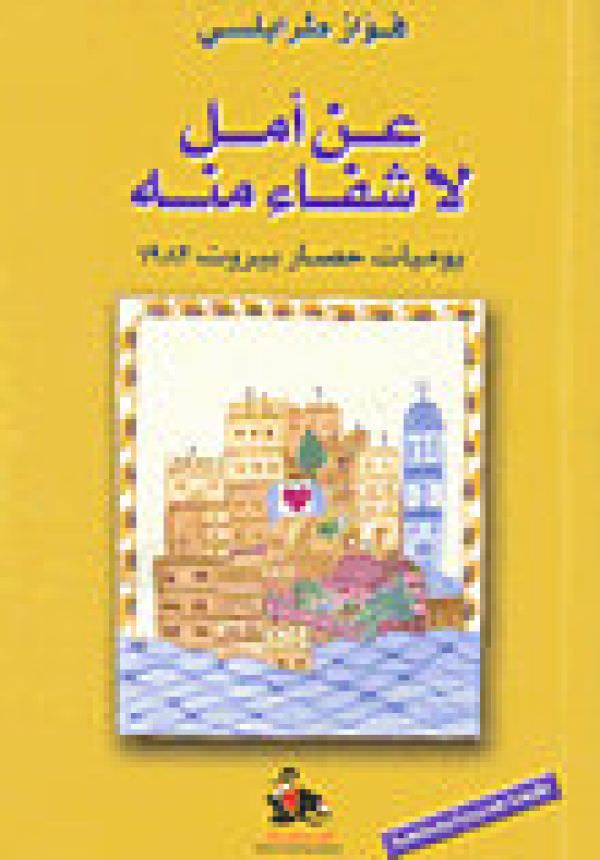
About a Hope with No Cure: Diaries of the Siege of Beirut, 1982
عن أمل لا شفاء منه: يوميات حصار بيروت 1982
Guide to the Book
This guide to the book presents the book's chapters and main lines of argument based on its actual contents; it is not a literal reproduction of the printed table of contents. A diary of the Israeli siege of Beirut, summer 1982 — written in real time between 8 June and 14 November. No chapters, no retrospective structure: only dated entries that mix war reporting (military movements, casualty counts, diplomatic manoeuvres) with personal observation (shelter life, street scenes, children), political analysis (Arab regimes, US policy, Israeli strategy), and literary reflection. The title comes from a passage by Alejo Carpentier on humanity's incurable hope for a better world despite suffering. First published October 1982; second edition revised January 2007, with a new preface written during the July 2006 war.
• Preface to the Second Edition (September 2006)
- Writing the second edition during the July 2006 Israeli war on Lebanon
- Correction: Israeli role in Bashir Gemayel's assassination
- Correction: the Wimpy café operation — carried out by Khaled Alwan of the SSNP, not a comrade of Adnan Halwani
Traboulsi explains that he was preparing the second edition when the July 2006 war broke out, giving the 1982 diaries renewed urgency. He corrects two factual points from the original text — a reminder that diaries written under siege carry their errors as part of their truth.
• June 1982: The Invasion and Early Siege
- 8 June — Day 4 of the invasion; Begin's address; cluster and phosphorus bombs on children
- 10 June — Rafael Eitan on UNIFIL; fall of Damour; Khaldeh triangle resists
- 12 June — Sanayeh Garden as refugee camp; Khalil Hawi's suicide (extended tribute); Brecht on poets' silence
- 15 June — Israeli forces surround Baabda palace; Sarkis forms six-member rescue committee (Gemayel, Jumblatt, Berri, Wazzan, Boutros, Maaloufi)
- 20 June — First meeting of the rescue committee; Walid-Bashir confrontation
- 22 June — Israeli officer: "Palestinians must die, they are a plague"; 48-hour ultimatums; car bomb on "National Unity Street"
- 23 June — Day 19; Cuban foreign minister Malmierca visits besieged West Beirut; meetings with Mohsen Ibrahim, George Hawi; Soviet embassy bombed
- 25 June — Heaviest bombardment yet (land, sea, air); Walid Jumblatt's historic stand and resignation from rescue committee
- 30 June — Begin refuses to commit to not invading Beirut; European summit condemns
The invasion begins on 6 June; by the 8th Traboulsi is writing. The entries record the fall of the south, the encirclement of Beirut, the suicide of poet Khalil Hawi on the day Israeli forces reached the capital, the formation of a rescue committee that includes both Walid Jumblatt and Bashir Gemayel, and the heaviest bombardment yet on 25 June. The diary's tone is set: factual precision laced with moral fury.
• July 1982: Tightening of the Siege
- 1 July — Reflections on Arab wars vs. Israeli war logic
- 3–4 July — Extended entries on daily life under bombardment
- 8 July — Le Monde Diplomatique article
- 11 July — Academic symposium in New York (5 July) on the invasion
- 22–31 July — The siege tightens; water and electricity cuts; diplomatic manoeuvres
July brings the slow strangulation of the city: water cut, electricity cut, supplies dwindling. The diary records the peculiar rhythms of siege life — the gap between New York symposiums debating Lebanon and the reality of living under daily bombardment. Traboulsi analyses the logic of Israeli warfare: not to win battles but to impose unbearable conditions on the civilian population.
• August 1982: The Worst Bombardment and PLO Departure
- 1 August — 101,000 shells on Beirut from 3:30 AM to 5 PM; airport seized; "only tactical nuclear weapons remain unused"
- 2 August — Anecdote about Yemen
- 5–6 August — "When you mistake the August moon for a flare, you are in Beirut"
- 9–12 August — Intensifying bombardment; negotiations for PLO departure
- 16–23 August — PLO evacuation arrangements; final days of the armed Palestinian presence
- 26–28 August — Departure of PLO fighters from Beirut
The worst month. On 1 August, 101,000 shells fall on Beirut between dawn and dusk — "only tactical nuclear weapons remain unused." The diary captures the surreal coexistence of apocalyptic bombardment and the small acts of daily survival. Then the negotiations: the PLO agrees to leave. The August entries are the book's devastating centre — the moment when the city's defenders depart and the population is left exposed.
• September 1982: Sabra and Shatila
- 1 September — Casualty statistics: 6,000–11,000 killed since June, 70% civilians, one-third under 15
- 9 September — Nouvel Observateur interview with Ariel Sharon
- 14–16 September — Events leading to the massacre
- 17 September — Sabra and Shatila massacre; armed men storm Akka Hospital, kill ten children
- 18–19 September — Sharon claims the massacre proves the army must stay
- 20–28 September — Aftermath; international reactions; daily entries on the shattered city
The PLO has left. The multinational force has withdrawn. On 16–17 September, the Sabra and Shatila massacre unfolds — armed men entering the refugee camps under Israeli floodlights. Traboulsi records the horror in real time: the storming of Akka Hospital, the killing of children, Sharon's cynical justification. The September entries are a document of witness, written in the immediate aftermath of what an Israeli commission would later call an act of genocide.
• October–November 1982: Aftermath
- 7 October — Joint statement by PSP, LCP, OCAL calling for end to raids and arrests
- 8 October — Poor and displaced demonstrate on the southern coast; six killed, 250 wounded; press raids
- 2 November — Resistance operations, including a bomb in Sidon
- 5 November — Walking through Beirut streets; commerce returns — boutiques, BMWs, consumerism; "Oger Liban" cleaning rubble; meditation on the buried homeland
- 14 November — Final entry: Corniche al-Manara as last breathing space; the sea widens as the homeland shrinks; children playing on the rocks; Marines photographing Lebanese like exotic animals; "O sea of Beirut!"
The diary's final entries trace the strange normalisation after catastrophe: commerce returning to ruined streets, BMWs appearing beside rubble, Oger Liban cleaning up the evidence. On 14 November, the last entry, Traboulsi walks the Corniche al-Manara — the sea is the only space left. Children play on the rocks while American Marines photograph them from a rubber boat, "like exotic animals." The diary ends with a cry: "O sea of Beirut!" — the incurable hope of the title, the city that refuses to die.
Back Matter
- About the Author — bibliography of authored and translated works