Democracy Is Revolution was published in the first years after the uprisings of 2011, and it insists that democracy is not a narrow procedural reform but a social and political struggle capable of transforming the structure of power itself. Fawwaz Traboulsi reads the Arab revolts from within their open moment, dwelling on the relation between street and organization, between freedom and social justice, and between the fall of despotism and the limits of transition. The book is therefore a defense of democracy in its radical sense, as transformative action rather than mere electoral routine.
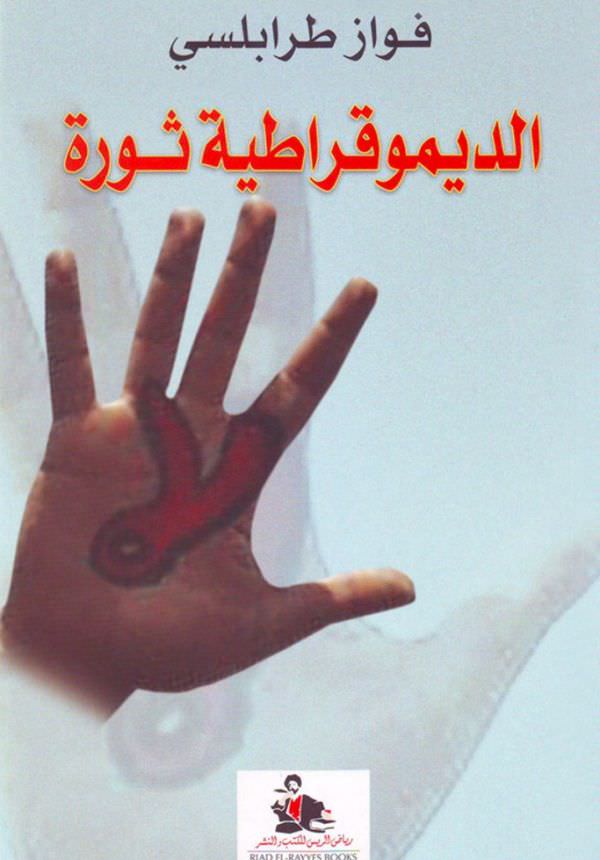
Democracy Is Revolution
الديموقراطية ثورة
Guide to the Book
This guide to the book presents the book's chapters and main lines of argument based on its actual contents; it is not a literal reproduction of the printed table of contents. Written in Beirut in October 2011, at the height of the Arab uprisings, this book's title declares its thesis: democracy is not a gift from above, a reform to be administered, or a stage to be reached — it is a revolution, a radical transformation of the relationship between rulers and ruled. The book is organised in two parts: extended analytical studies and shorter journalistic articles, both addressing the uprisings as they were unfolding. Dedicated to Jarallah Omar and Abdel Rahman al-Nu'aimi — two Arab democrats who paid for their convictions.
Part I — Studies
1 Revolutions Topple Systems of Ideas Too!
- "The people want the fall of the regime": a revolution in concepts
- The neoliberal system of ideas: five demolished pillars
- Identity: the culturalist-religious definition and "Islamic exceptionalism"
- Politics: the civil society/state theory and its "democratic deficit"
- Economics: dismantling the developmental state, privatisation, micro-credit
- Social affairs: measuring poverty rates, not inequality
- International: the "war on terror" and the security doctrine
- The people and the system versus civil society
- The priority of politics
- Youth unemployment and work opportunities
- Banditry, not mere "corruption"
- American "democratic transformation" policy: between interests and ideology
- Formulas for the democratic project
The book's longest and most theoretically ambitious study argues that the Arab uprisings were not merely political events but an intellectual earthquake — a practical critique, "by blood," of an entire system of ideas that had dominated the region for a quarter-century. Traboulsi identifies five pillars of this system that the uprisings demolished: the culturalist definition of Arab societies by religion alone ("Islamic exceptionalism"); the civil society/state binary imported from neoliberal theory; the reduction of social demands to "good governance" and "anti-corruption"; the youth unemployment crisis masked by GDP growth statistics; and the corruption discourse that treated theft of public wealth as a bureaucratic problem rather than a structural feature of the ruling class. The study analyses the revolutionary slogan "the people want the fall of the regime" (al-sha'b yurid isqat al-nizam) as a conceptual revolution: it rehabilitated the concept of "the people" against the neoliberal fragmentation of identity; it restored sovereignty to the people as the source of all legitimacy; and it rediscovered that the political system — not individual dictators — was the target of change. As Slavoj Zizek noted, the uprisings were a "miracle" — an event that no one predicted because the research was being conducted in the wrong field, with the wrong tools.
2 No Freedom without Equality
- "Work, freedom, bread": the indivisible slogan
- Against the arbitrary separation of the political and the economic
- Work as a citizen's right, not a secondary demand
- No freedom without equality: political and legal equality
- Social movements and political change: the Brazilian experience
- The bread intifadas and their political consequences
- Dignity: confronting work, bread, and repression
- American "democratic transformation": between interests and ideology
This study examines the relationship between social movements and political change through the twin slogans of the Arab uprisings: "the people want the fall of the regime" and "work, freedom, bread." Traboulsi argues against the arbitrary separation — promoted by neoliberal ideology and adopted by many NGOs — between the political demand for freedom and the economic demand for bread and work. He demonstrates that "work" ('amal) is not a secondary addition to the demand for freedom but a right — a citizen's right — and that democracy without social rights is an empty shell. The study surveys the relationship between social movements and democratic transformation historically — from the Brazilian experience of the 1970s-1980s to the Arab uprisings — concluding that the slogan "work, freedom, bread" expressed the demands of the broadest popular coalition: workers, peasants, artisans, the rural poor, and the urban dispossessed who revolted not only for political rights but for social rights — the right to education, housing, health, and liberation from poverty.
3 Arabism and Nationalist Ideology: An Arabism for the Present
- Distinguishing 'uruba (Arabism) from Arab nationalism (ideology)
- The erasure of the present: oscillation between mythologised past and voluntarist future
- The past: burden or stimulus?
- "Consumptionist envy": measuring progress against the West
- Unionism and fragmenting unionisms
- The economic carrier: inter-Arab trade at 7–10%
- The value of work in a culture of oil and consumption
Traboulsi distinguishes between 'uruba (Arabism — the objective national bond of language, culture, territory, and shared history) and Arab nationalism (al-qawmiyya al-'arabiyya — an ideology adopted by political movements, states, and regimes). This distinction allows him to critique nationalist ideology without abandoning Arabism itself. The study identifies several pathologies of nationalist thought: the oscillation between a mythologised past and a voluntarist future that erases the present; the "consumptionist envy" that measures Arab progress against Western achievement rather than against its own goals; the obsession with unity/fragmentation that obscures internal responsibilities; and "fragmenting unionism" — regimes that demand unity while practising sectarian, ethnic, and regional discrimination. The study's most original argument is that the economic dimension of Arabism has been systematically neglected: inter-Arab trade amounts to only 7-10% of total trade, and without economic integration, political unity remains an empty slogan. The uprisings, by reasserting the people's will across borders, restored the region's identity as "Arab" — and the world began speaking of "Arab revolutions" rather than "Middle Eastern" events.
4 Democratic Transformation: A Historical Approach
- Introduction: theories produced in one context are not necessarily applicable elsewhere
- Preliminary observations: intellectual production in the South
- The public sphere in the European democratic experience
- Habermas on the bourgeois public sphere as a precondition
- The role of non-bourgeois forces in European democratisation
- Public spheres in the Arab world: from Muhammad Ali to the Tanzimat
- The press and literary salons of Beirut and Cairo
- Peasant revolts: Tanyus Shahin's 1858 uprising
- Colonialism: introducing modern institutions while blocking democratic development
- Post-independence authoritarian regimes and the destruction of civil society
This is the study's most theoretically demanding essay — a comparative historical analysis of democratic transformation drawing on Jürgen Habermas's concept of the public sphere. Traboulsi argues that theories produced within a specific national context — in this case, Western Europe and North America — are not necessarily applicable elsewhere without critical examination. He engages Habermas's thesis that the bourgeois public sphere was a precondition for democratic transformation in Europe, then tests it against the Arab experience. The study traces the emergence of public spheres in the Arab world — from the Egyptian urban development under Muhammad Ali, through the Ottoman Tanzimat, the press and literary salons of Beirut and Cairo, the peasant revolts of Mount Lebanon (including Tanyus Shahin's 1858 uprising), to the post-independence nationalist movements. It concludes that two historical forces repeatedly disrupted the emergence of democratic public spheres in the Arab world: colonialism (which simultaneously introduced modern institutions and blocked democratic development) and the post-independence authoritarian regimes that destroyed civil society in the name of national unity.
5 Oil and Democracy
- The "resource curse" thesis and its limits
- Timothy Mitchell: the political economy of oil extraction
- The rentier state: from tax-collecting to distributing entity
- Oil revenues and the abolition of accountability
- After 1973: oil removed from the battle
- Oil as mechanism of dependency, not sovereignty
This study addresses the relationship between oil wealth, authoritarianism, and democracy in the Arab world, engaging the work of Timothy Mitchell and challenging the "resource curse" thesis. Traboulsi argues that the problem is not oil itself but the political economy of oil extraction: who controls the revenues, how they are distributed, and what kind of state they produce. The study traces how oil transformed the Arab state from a tax-collecting entity (accountable to taxpayers) into a distributing entity (accountable to no one), and how this "rentier" model created a structural obstacle to democratisation. But Traboulsi refuses the determinism of the "curse" thesis, showing that oil-producing states are not inherently undemocratic — they are undemocratic because specific class alliances, imperial interventions, and institutional arrangements have made them so. The study's conclusion is sharp: after 1973, Arab oil was removed from the battle as a pressure tool for a just solution to the Arab-Israeli conflict and became hostage to Western banks, corporations, and arms deals — transforming the region's principal natural resource from a potential instrument of sovereignty into a mechanism of dependency.
6 Edward Said in His Intellectual Evolution: From East/West to the Realm of Humanism
- Rescuing Said from reduction to a single book
- First moment: Orientalism (1978) — knowledge serving imperial power
- Second moment: Culture and Imperialism (1994) — resistance literature and acknowledged omissions
- Third moment: Humanism and Democratic Criticism (2004) — beyond the East/West binary
- The trajectory: from Foucault's knowledge/power to humanist universalism
- Said as "translator": an Arab writing in English
- The ultimate achievement: a humanist, democratic, secular language
This study — written for the 30th anniversary of Orientalism — is an attempt to rescue Edward Said's thought from its reduction to a single book. Traboulsi identifies three "moments" in Said's intellectual development: the critique of Orientalism (1978), which exposed how Western knowledge of the East served imperial power; Culture and Imperialism (1994), which expanded the analysis to resistance literature and acknowledged Said's earlier omissions; and the culminating moment of secular democratic humanism in Humanism and Democratic Criticism (2004), where Said moved beyond the East/West binary altogether. Traboulsi argues that Said's trajectory — from the knowledge/power binary of Foucault through the authority/position/interests triad to the final humanist universalism — represents not an abandonment of his earlier positions but their dialectical transcendence. The study concludes with a powerful analysis of Said as "translator" — an Arab who wrote in English, who spent his life "translating" American imperial strategies into a language his Arab compatriots could understand, and whose ultimate intellectual achievement was the articulation of a humanist, democratic, secular language that had transcended the binaries and hostile identities that define our age.
Part II — Articles
Articles on the Arab Uprisings (2010–2011)
- Obama and the elections of the Arab Spring
- Oil and democracy
- When rulers speak of mistakes
- George's "tears" and Tony's "democracy"
- On the fair distribution of hope
- Hope smells of jasmine
- Democracy is revolution
- Revolution is a festival
- Down with the tyrant!
- ...And another tyrant must fall
- Bernard Lewis and Arab democracy
- "The people want to implement the constitution!"
- Yemen: lest the tribe beget... a tribe
- The Turkish recipe and the art of reading demonstrations
- They still aspire to external legitimacy!
- Incitement to commit an error
- Mumana'a in the crisis of mumana'a
- The current of change in Syria
- The Turkish role: from advice to threat
- Yemen at the crossroads
- Oil, sovereignty, and democracy
- Guarding Syria
- In the document of the Syrian opposition
- Saleh's return and women's rights
- Cairo, 9 October: let the event remain an event
The second part collects 25 weekly columns written as the uprisings unfolded across Tunisia, Egypt, Libya, Yemen, Bahrain, and Syria. Written in real time — between April 2010 and October 2011 — these articles capture the intellectual excitement, political risk, and analytical difficulty of responding to events that no theory had predicted. The articles range from sharp political commentary (Obama's hypocrisy in cutting democracy-promotion budgets while the Saudi king is guest of honour at the French 14 July celebrations) to theoretical interventions (a devastating critique of Bernard Lewis's claim that democracy is alien to Arab-Islamic culture) to real-time analysis of the Syrian revolution's trajectory. Throughout, Traboulsi insists on two principles: that the uprisings came from below, against both local autocracies and their Western sponsors; and that democracy is inseparable from social justice — "no freedom without equality."
Back Matter
- Index of Names
- Index of Places