This volume of History of Eastern Families is devoted to the Bekaa, from Zahle and the western plain to Baalbek and Rashaya, and it is among the richest and most expansive parts of the series. Issa Iskandar al-Ma'louf documents family origins, migrations, demographic change, and religious and social ties, turning genealogical record into a way of reading the history of a region shaped by movement between plain, mountain, and border. Its value lies in preserving a rare social memory of the Bekaa not as a periphery, but as one of the centers of Lebanese history.
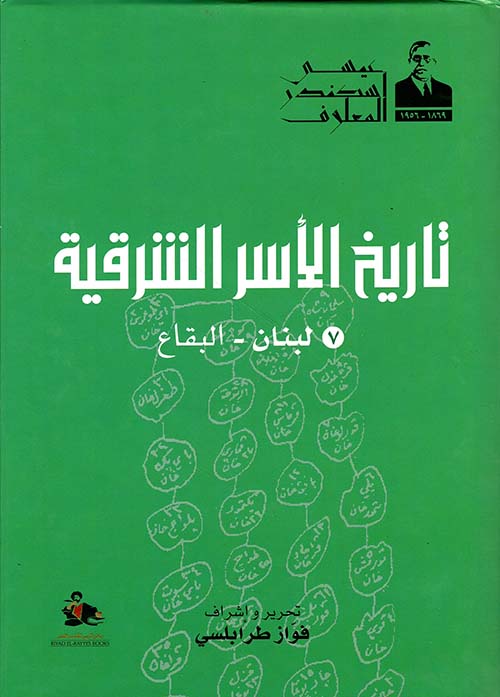
History of Eastern Families, Vol. 7: Bekaa Valley
تاريخ الأسر الشرقية ٧ - لبنان: البقاع
Guide to the Book
This guide to the book presents the book's chapters and main lines of argument based on its actual contents; it is not a literal reproduction of the printed table of contents. The seventh and final volume of the encyclopaedia — by far the largest in the series at 639 pages, reflecting the Bekaa Valley's vast geography and the complexity of its family networks. Covering the districts of Western Bekaa, Rashaya, Zahleh, and Baalbek, it documents hundreds of families from Ain Zbadeh and Qaraaoun to Mashghara, Zahleh, Baalbek, and Hermel. Issa Iskandar al-Maalouf (1869–1956) — himself a native of the Bekaa (born in Kfaraqab near Zahleh) — brings personal knowledge and local connections to this volume, recording inter-family conflicts, tracing families of Ayyubid-Kurdish origin and Egyptian provenance, and documenting Bedouin tribes that settled in the plain. The volume is a social narrative of a region shaped over centuries by migration, conflict, and sectarian transformation.
1 Western Bekaa District (قضاء البقاع الغربي)
- Ain Zbadeh (عين زبدة) — families and their origins
- Al-Qara'oun (القرعون) — the Banu al-Mir feud with Banu Haymour: the Haymouris (ancient Arab family of the Hamra' Beqa'iyyin) killed 10 brothers of the Banu al-Mir on the threshing floors of Ba'loul; one survivor fled to Damascus
- Kamid al-Lawz (كامد اللوز), Lathla (لاثلا)
- Mashghara (مشغرة) — major town; families including al-Nahhas/Shaheen (possibly from Baalbek), Tarabulsi, al-Adawiyyun, Arram, al-Ayr, Qadri, Qulai'ani, Qaym
- Al-Mansourah (المنصورة)
- Ba'loul (بعلول) — families: Barakat, Sheikh Omar (claim Qadiri descent)
- Jubb Jinnin (جبّ جنّين) — mixed Muslim and Christian; Muslim families: Banu Haymour (ancient, from the Hamra' Arabs), Banu al-Dusuqi (from Egypt, dispersed across Jubb Jinnin, Sultan Ya'qub, Aytanit, Nabi Safa Damascus)
- Hammara (حمّارة) — formerly half Christian, half Muslim; today entirely Muslim after sectarian events; Banu Ayyub (half the village, of Ayyubid-Kurdish origin, possibly from Salah al-Din's retinue, ~700 souls), Abu Yasin, Abu Ali, Baydoun; dispersed branches in Nablus, Safed, Bint Jbeil
- Khirbat Qanafar (خربة قنافار) — Druze: Wahbeh and Arram; Orthodox: Karam family (from Jerusalem via al-Farzol then Ehden); Catholic: Banu Hatoum (multiple branches: Muslim in Qabb Elias, Druze in Kfar Salwan, Maronite in Amatour)
The opening section covers the fertile western plain of the Bekaa, where al-Maalouf documents a strikingly diverse population: Sunni families of Ayyubid-Kurdish descent, ancient Arab Bedouin clans, Druze communities, and Christian families of multiple confessions. The feud between Banu al-Mir and Banu Haymour — in which ten brothers were killed on a single day — exemplifies the violent inter-family conflicts that shaped Bekaa society. The entry on Hammara records a village's complete demographic transformation from mixed to exclusively Muslim.
2 Rashaya District (قضاء راشيا)
- Rashaya (راشيا) — main town; Druze, Muslim, Christian
- Al Zaki (آل زاكي) — Druze religious judges (qadis) of Rashaya; held judicial office for generations until 1870; authority extended to Hasbaya, Iqlim al-Ballan, and the Bekaa
- Al Aryan (آل العريان) — Druze political sheikhs, from the Aleppo highlands; major political dynasty; ancestor Sheikh Ammoud buried near Damascus
- Banu Barghsha (بنو برغشة) — oldest Druze family, predating Al Aryan
- Aita al-Fakhkhar (عيتا الفخّار) — all Orthodox; families from Btighrin, Hisn al-Akrad, the Qalamoun; al-Gharib, al-Hussan, al-Qassis, Barbara, al-Sakkaf, al-Maaluli (dated 1451 AD)
- Villages: Ayha (ancient, on Damascus road), Ain Arab, Kafrquq, Majdal Balhiss (3/4 Muslim, 1/4 Christian), Halweh, Baka, Deir al-'Asha'ir (transferred from Wadi al-Ajam 1777)
The Rashaya district, perched between Mount Hermon and the Bekaa plain, is documented with its Druze-majority villages, Christian minorities, and the intricate family connections linking it to Damascus, the Wadi al-Ajam, and the Western Bekaa. Al-Maalouf records the administrative transfer of villages between districts and the family histories that span these boundaries.
3 Zahleh District (قضاء زحلة)
- Zahleh — the largest section of the volume; overwhelming Christian city (Maronite, Greek Catholic, Orthodox)
- Al-Muallaqah (المعلقة) — 179 Maronite families, 317 houses, 4,173 residents documented from Bishop Beshara al-Shamali's 1921 pastoral tour; each family's origin traced to a specific Lebanese or Syrian village
- Key families — Banu al-Fahl (from Baskinta), Abu Muhayya (from the Metn), Banu al-Alam (from al-Aqoura; killed Ottoman pasha of Tripoli to rescue their sister), Banu Shamoun (from Tannourin), Banu al-Abras (from Baalbek, one of the oldest), Banu Abi Haydar (from Houran via Baskinta), al-Sayfi (from Baalbek to Damascus; founded the Greek Catholic/Melkite patriarchate), al-Maalouf (author's family, from Kfaraqab)
- Systematic 1918 demographic survey — village-by-village religious composition (Muslim, Shiite/Metawali, Druze, Christian) across every Bekaa village
- Surrounding villages — Qabb Elias, Sultan Ya'qub, Bar Elias, Kfar Zabad (Orthodox), Jdita (ancient ruins), Riyaq, al-Farzal (former Orthodox bishopric destroyed under Harfush pressure)
Al-Maalouf's documentation of Zahleh — the great Greek Catholic city of the Bekaa and his own homeland — carries particular personal authority. He traces the commercial dynasties that made Zahleh the trading hub of the valley, records the families who rebuilt after the 1860 destruction, and documents the surrounding villages whose families intermarried with Zahleh's urban elite. The Zahleh section is likely the most personally informed in the entire seven-volume series.
4 Baalbek District (قضاء بعلبك)
- Harfush dynasty (الحرافشة) — ruling emirs of Baalbek for centuries; their oppressive rule drove systematic Christian displacement, a leitmotif across the section
- Shiite sayyid families — Al Murtada (descended from Imam Musa al-Kazim, from Iraq via Qamhaz); al-Sayyad (Husayni sayyids of Munaytra, from al-Fouah near Aleppo); Banu Hamdar (taught in Najaf); authenticated nasab lineage documents reproduced
- Hamadi sheikhs (المشايخ الحماديون) — 14 sub-clans classified with geographic distribution across Hermel, Hadath, Yamouneh, Batroun, Jubail; from Banu Madhij, supporters of Imam Husayn
- Banu al-Tabsharani (بنو التبشراني) — the most dramatic narrative: an entire Christian village destroyed after a woman struck a Harfush soldier at a spring; family scattered to seven locations; proverb: "the stone of Tabshar destroyed seven villages and returned"; ~1,600 descendants in Brazil as "Tichari"
- Dandash (آل دندش) — Bedouin raiders from Hermel who terrorised northern Bekaa; Ottoman garrison at Bakdash built specifically to contain them
- Banu Zaghib (بنو زغيب) — Shiite in Younin; from Iraqi Jasham tribe via Houran; Ali Agha resisted Ibrahim Pasha
- Christian families — Banu Habashi (oldest Maronites of Deir al-Ahmar), Banu al-Hulait (from Raas Baalbek, killed a Harfush prince), al-Sayfi (from Baalbek to Damascus, founded the Melkite patriarchate); Raas Baalbek destroyed multiple times, family-by-family accounts of who fled where
- Brital (بريتال) — ~160 houses, all Shiite; Shamsatar (شمسطار) — major Shiite presence; al-Qaa (القاع) — originally mixed, now Christian; proverb: "may the fate of Qaa's Muslims befall you"
The final section covers the vast Baalbek district from the ancient city northward to Hermel on the Syrian border. Al-Maalouf documents the complex layering of populations: ancient Sunni and Shiite families, Bsharri Maronite settlers who colonised the plain (documented in parallel in Volume 2), Kurdish-Ayyubid families tracing their ancestry to the Crusader era, and tribal communities of the northern reaches. The section on Hammara's Banu Ayyub — who claim descent from Salah al-Din's entourage — exemplifies the Bekaa's role as a crossroads where diverse populations settled over centuries.
Back Matter
- Index of Families and Notable Figures
- Index of Places
Notes
Vol 7 of 7. Original author: عيسى إسكندر المعلوف (1869-1956). Verified (تحقيق) by فواز طرابلسي. First edition, hardcover, 24×17cm.