Portrait of the Boy in Red is a personal memoir, but it is also the portrait of a Lebanese and Arab generation seen through family, study, political work, war, and exile. Fawwaz Traboulsi writes his life from within, not in order to separate the private from the public, but to see how individual experience is formed inside a time dense with upheaval and rupture. The importance of the book lies there: it does not present a solitary hero, but a self whose path reveals a wider world of leftist hope, Lebanese fracture, and changing meanings of commitment.
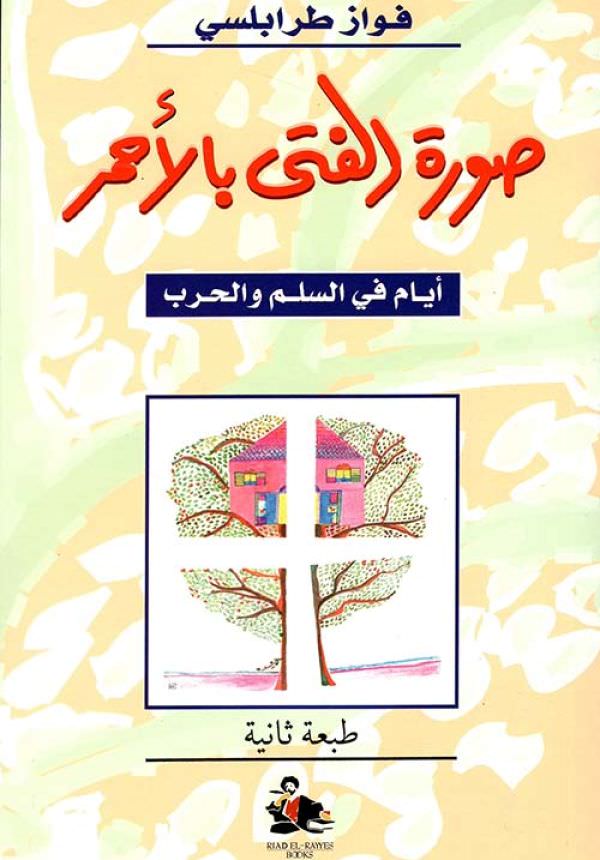
Portrait of the Boy in Red: Days in Peace and War
صورة الفتى بالأحمر: أيام في السلم والحرب
Guide to the Book
This guide to the book presents the book's chapters and main lines of argument based on its actual contents; it is not a literal reproduction of the printed table of contents. A memoir spanning four decades of political engagement in Lebanon and the Arab world — from a childhood between the tanneries of Mashghara and the hotels of Bhamdoun, through the radical left politics of the 1960s and 70s, the Lebanese civil wars, the 1982 Israeli siege of Beirut, exile in Paris, and the elegiac return to destroyed homes. The title evokes a self-portrait: the boy in red, the colour of revolution.
1 Paradoxes of Residence and Belonging
- The Tannery — Mashghara, its springs, sounds, and the family leather trade
- The Hotel — Bhamdoun, the father's hotel business, mountain resort culture
- The Library — Early reading, intellectual formation, schooling at the Lazarist nuns and International College
Traboulsi's origins between three formative spaces: the ancestral village of Mashghara in the western Beqaa with its tanneries and springs; the family hotel in the mountain resort town of Bhamdoun; and the library that opened the world of books. A childhood shaped by the sensory landscapes of rural Lebanon and the cosmopolitan milieu of Beirut's foreign schools.
2 An Education
- In Injury Time — Early political consciousness, the Arab nationalist milieu of the 1950s
- The Arab Students' Club — Student politics in Beirut
- The Path (al-Nahj) — Early encounters with Marxism and communist thought
- London — Studies in Britain, intellectual encounters with the British left
Political awakening during the turbulent 1950s — from the Arab Students' Club in Beirut to first encounters with Marxist thought and the journey to London for university studies. The chapter traces the formation of a young radical intellectual against the backdrop of Nasserism, the Suez crisis, and the 1958 Lebanese crisis.
3 The Travails of the Sixties
- Revolution in Aden — The South Yemen independence struggle
- At the Palestine Office — Early involvement with the Palestinian cause
- June — The 1967 Six-Day War and its shattering impact
- The Road to the Mountain — The turn toward armed struggle
The radicalization of the 1960s: witnessing the South Yemeni revolution, working at the Palestine Office in Beirut, and the devastating shock of the June 1967 defeat that pushed an entire generation toward armed resistance. The chapter ends with the turn to the mountain — literally and figuratively — as the path to revolutionary politics.
4 Qarmatians of the Periphery
- Aden — Revolutionary South Yemen, the NLF experience
- Dhofar — The Dhofar rebellion in Oman, guerrilla visits
- Amman of the Fedayeen — The Palestinian resistance in Jordan before Black September
The radical left at the margins of the Arab world — named after the Qarmatians, the medieval egalitarian movement. Traboulsi moves between revolutionary Aden, the Dhofar guerrilla front in Oman, and the fedayeen camps in Jordan, immersed in the networks of the Organisation of Lebanese Socialists (OCAL) and the broader New Left that sought to fuse Marxism with Arab liberation.
5 Seventies of Hopes and Disappointments
- Lebanon-Palestine — The intertwined fates of the Lebanese and Palestinian lefts
- The Lebanese Resistance — The Lebanese National Movement
- Hadramawt — A journey to South Yemen
- Revolution in Ethiopia — Witnessing the Derg revolution
- The Beqaa — Political organizing among Beqaa Valley communities
The 1970s oscillate between revolutionary hope and bitter setback. The chapter follows the deepening entanglement of the Lebanese and Palestinian causes, the formation of the Lebanese National Movement under Kamal Jumblatt, trips to South Yemen and revolutionary Ethiopia, and grassroots organizing in the Beqaa Valley — all under the gathering storm of civil war.
6 Reform by Arms (I)
- Shebteen's Bells — The early phase of the civil war, sectarian geography
- The Mountain — Fighting in Mount Lebanon
- Tal al-Zaatar — The siege and massacre of the Palestinian refugee camp
- The Red Prince — Political alliances and the leftist-Palestinian coalition
The eruption of the Lebanese civil war in 1975. Traboulsi recounts the opening battles — the shifting front lines, the sectarian mapping of Beirut, the battle for Mount Lebanon, and the catastrophic siege of the Tal al-Zaatar refugee camp in 1976. "The Red Prince" refers to the political alliances forged between the Lebanese left and the Palestinian resistance under the Lebanese National Movement.
7 Reform by Arms (II)
- The South — Fighting in southern Lebanon
- Syria — The Syrian intervention and its consequences
- Arab Beirut — West Beirut as a political and cultural space
- The War on the Camps — Intra-Lebanese and inter-Palestinian conflicts
The civil war continues with the Syrian military intervention of 1976, the shift of fighting to the south, and West Beirut's transformation into a besieged republic of letters and arms. The chapter charts the escalating violence against Palestinian refugee camps and the internal fractures within both the Lebanese and Palestinian movements.
8 After Peace
- In Africa — Political engagements on the African continent
- Yemen — Return visits to South Yemen
- Cairo — Intellectual and political life in Egypt
- An-Nahar al-Arabi wal-Dawli — Journalism and editorial work at the international edition of An-Nahar
The interwar period between the Two Years' War (1975–76) and the 1982 Israeli invasion. Traboulsi travels to Africa, returns to South Yemen, engages with Cairo's intellectual scene, and takes up journalism at An-Nahar al-Arabi wal-Dawli — the international edition of Lebanon's leading daily. A pause between storms.
9 The Siege of Beirut
- The Southern Front — The initial Israeli assault of June 1982
- Siege — The encirclement of West Beirut
- Beirut's Steadfastness — Resistance during the 88-day siege
- Negotiations for Departure — The PLO evacuation talks
The Israeli invasion of Lebanon in June 1982 and the 88-day siege of West Beirut — the defining trauma of Traboulsi's generation. From the initial assault on the southern front to the encirclement of the capital, the daily bombardment, and finally the negotiated departure of the PLO. A companion piece to Traboulsi's diary About a Hope with No Cure, written during the siege itself.
10 The Bougainvillea
- The Green Notebook — A diary-style account of the invasion's aftermath
- Sabra and Shatila — The massacre and its aftermath
- The National Resistance — Formation of the Lebanese resistance against Israeli occupation
- "In Iraq They Call It the Den" — Clandestine resistance work, visits to Baghdad
Named after the flowering vine that survived the bombardment. The chapter covers the aftermath of the siege: the Sabra and Shatila massacre of September 1982, the birth of the Lebanese National Resistance against Israeli occupation, and the clandestine networks that sustained the struggle. Traboulsi's Green Notebook captures the raw immediacy of those days.
11 A Transport Crisis
- The Metro and the Eyes — The Paris metro, human interactions, racism, Arab immigrants in France
- The Orient Express — Encounters on a train between Paris and Geneva
- The Transport Strike — Conversations with a Moroccan taxi driver about Arab identity
- The New Poverty — A young woman's plea in the metro
- Fashion Show — The story of Marseil Bichon dying alone in Paris
- Cats and Dogs: Statistical Marginalia — French obsession with pets versus humans
- The Naive Lover's Fantasy — An encounter in the metro
- In Chatelet Metro — An incident of sexual assault witnessed
- The Return of Sagawa — The Japanese cannibal's story in Paris
- What Eglin Said — August 1985 events in Paris
Exile in Paris, refracted through the city's transport system. A series of vignettes — encounters in the metro, on trains, in taxis — that illuminate the condition of the Arab exile in Europe: racism, loneliness, the "new poverty," and the surreal juxtapositions of life in a Western capital while Beirut burns. Sharp literary observations that blend sociology with memoir.
12 The French Aspect
- Mahmoud Darwish's Heart — Darwish's heart surgery in Vienna
- Where Water Became a Commodity — Chatel-Guyon spa town, French capitalism
- The Battle for the Liberation of Paris — The 40th anniversary commemoration
- Land and Honour — Between Israelis and Arabs — Analysis of the film Riyah al-Khamsin
- Beirut Between Tatars and Mongols — The intra-militia wars of 1985
- Contraception — A satirical piece on the Tripartite Agreement
- Spain Without Civil War — A Mediterranean writers' conference in Valencia
- The Number 17 — Parallels between Spanish and Lebanese sectarianism
- In the Closet of Memories — Conversations with a Spanish Civil War veteran
- Guernica in Its Homeland — Seeing the original painting
- Terrorism and Epilepsy — Airport security encounters as an Arab
- The Pigeon — Artificial birds in a Paris park and John Berger's aesthetics
- The Pigeon Did Not Fly — Peace pigeons and Lebanon
- Hassan Hamdan's Long Day — The assassination of Mahdi Amel
Cultural and political observations from France and Spain during the exile years. A mosaic of essays linking the personal and the political: Mahmoud Darwish's brush with death, the commodification of water, Guernica as mirror for Beirut, the parallels between Spanish and Lebanese sectarianism, and the assassination of the Marxist philosopher Mahdi Amel (Hassan Hamdan). The chapter weaves together art criticism, travel writing, and political analysis.
13 Bisecting the Andalusian House
- The Fountain — Dreaming of an Andalusian fountain, symbol of lost home
- Zuqaq al-Balat — The Beirut neighbourhood where love was born, political life in the 1970s
- Mar Nqoula Neighbourhood — Militia intimidation and sectarian cleansing
- Jaj — The mountain village, its burning during the war
- The Hotel — The destruction of the Bhamdoun hotel during the 1983 Mountain War
- The Swan — A flamingo wounded during wartime gunfire near the old family house
- Ras al-Jabal — The family's summer house, Israeli invasion, displacement
- Mufti Muhammad Alaya Street — A military raid, confiscation of books and documents
- Mashghara — An elegy-poem to the ancestral village and its lost landscape
An elegy for every home the war destroyed. Traboulsi returns — in memory and in person — to the places that shaped him: the Beirut neighbourhood of Zuqaq al-Balat, the mountain village of Jaj burned by militias, the Bhamdoun hotel reduced to rubble in the Mountain War, the family house at Ras al-Jabal overrun by the Israeli invasion, and finally Mashghara itself, the ancestral village. The "Andalusian house" — bisected, like Lebanon — becomes the governing metaphor for irreparable loss.
Back Matter
- Index of Names
- Index of Places