This part focuses on the families of Beirut, offering a portrait of the city through its households, notables, charitable institutions, civic bodies, and ties to confessional and urban life. Here Issa Iskandar al-Ma'louf treats genealogy as an entry into the city’s social history, where trade, education, associations, and municipal councils stand beside family formation and family role. The volume is especially valuable as a source on prewar Beirut, when urban life was also written through networks of kinship, neighborhood, endowment, and institution.
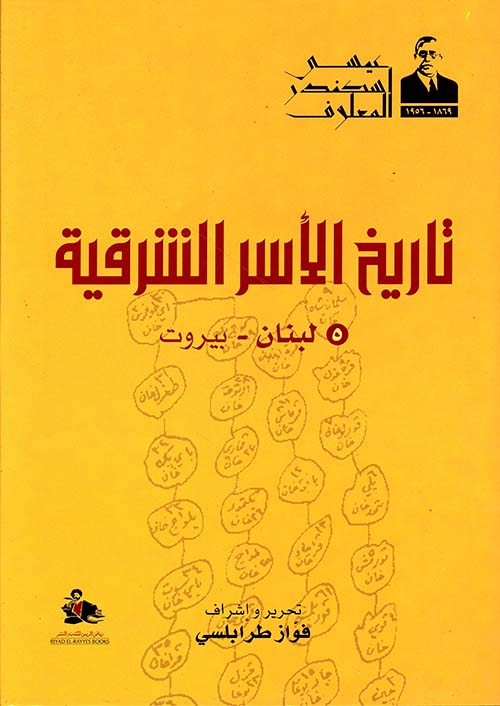
History of Eastern Families, Vol. 5: Beirut
تاريخ الأسر الشرقية ٥ - لبنان: بيروت
Guide to the Book
This guide to the book presents the book's chapters and main lines of argument based on its actual contents; it is not a literal reproduction of the printed table of contents. The fifth volume of the seven-part encyclopaedia, focused on the families of Beirut — the shortest in the series, reflecting the city's concentrated urban character compared to the sprawling rural districts. Unlike the other volumes organised by geography, al-Maalouf structures this volume around confessional communities and the city's notable families, documenting the great "Seven Families" of Beirut, its Orthodox charitable society, its municipal council, and its Muslim scholarly lineages. Drawing on property deeds, personal testimony, and archival documents from the 18th and 19th centuries, the volume captures Beirut's transformation from an Ottoman provincial town to the cosmopolitan centre of the Nahda.
1 The Seven Families of Beirut (العائلات السبع)
- Bustros (بسترس) — Greek Orthodox; one of the most prominent families
- Turad (طراد) — Greek Orthodox; extensive genealogical tree
- Saba (سابا) — Greek Catholic
- Daqr (داقر) — Maronite
- Fayyad (فياض) — Greek Orthodox; based in al-Shiyyah
- Tuwayni (تويني) — Greek Orthodox; based in Haret Hreik
- Frangieh (فرنيني/فرنجية) — based in Burj al-Barajneh
- Their charitable society (1895–1897) — president Gibran Tuwayni; members including Sursock, Fayyad, Turad, Bustros families
- Beirut Municipal Council (1897) — Mahmoud al-Khoja, Nakhla Tuwayni, George Naqqash, Niqula Mansa, Habib Turad, Muhyi al-Din Hamadeh, Ibrahim Tabbara, Girgis Bustros, Nakhla Sursock
The volume opens with the seven leading families who dominated Beirut's social and political life, primarily Greek Orthodox with Maronite and Catholic branches. Al-Maalouf documents their charitable institutions and municipal governance, providing a snapshot of Beirut's civic elite in the late Ottoman period.
2 Christian Families of Beirut
- Comprehensive family register — 45+ families listed alphabetically: Iddeh, Ahdab, Arnaut, Asfar, Bakhous, Barbari, Bustros, Bashbash, Thabet, Tuwayni/Rizqallah, Judd, Dabbas, Dusuqi, Dahhan, Rabat, Sursock, Sham'a, Sabbagh, Turad, Tarazi, Abd al-Nour/Sarrouf/Ajami, Arman, Akka, Ayyarout, Fattal, Farzli, Fir'awn, Qissis, Qassir, Qatta
- Orthodox families of Beirut (1911/1917) — Sursock, Bustros, Fayyad, Turad, al-Ha'ik, Yunus
- Banu Iddeh (بنو إدّه) — extensive genealogy from Iddeh village in Jbeil; ancestor al-Haj Yonnan from Deir al-Ahmar; branches: Sheikh Mansour (built Mar Girgis church in Beirut), Michel Iddeh (dragoman of Beirut vilayet), Antwan Youssef Iddeh (1951); linked to Habish of Ghazir
- Hadath Beirut (حدث بيروت) — Orthodox: Shuwayri/Maja'is, al-Sa'igh (from Banu al-'Azar of Amioun), al-Khouri (from Ka'di Baskinta); Catholic: al-Haddad (from Beit Shabab); Maronite: Salih al-Ajami (from Dafoun)
- Al-Shiyyah (الشياح) — families: al-Ashqar, Ghosn, al-Habbaqi (from Jbeil), Latif (from Deir al-Qamar)
- Haret Hreik (حارة حريك) — families: al-Tahoumi, al-Adaymi
- Burj al-Barajneh (برج البراجنة) — Christians: Matta, al-Bustani; Shiite: al-Arab
The most extensive section, documenting over 45 Christian families across Orthodox, Catholic, and Maronite communities. Al-Maalouf provides detailed genealogical trees — most notably for the Iddeh family, whose migration from Jbeil to Beirut spans centuries — and documents the suburban villages of Hadath, al-Shiyyah, Haret Hreik, and Burj al-Barajneh, each with its distinct confessional character.
3 Muslim Families of Beirut
- Scholars and notables (1917) — Mustafa al-Naja (mufti of Beirut), Hasan al-Attar, Hasan al-Mudawwar (amin al-fatwa), Abd al-Basit al-Ansi, Muhammad Salih al-Faruqi, Mahmud Farshoukh, Husayn Muhyi al-Din al-Hibbal, Adib Muharram
- Old Muslim families (قدماء) — Tabbara (of Maghrebi Husayni origin), Banu Khattab, Sa'adeh (Maghrebi), Da'ouq (wealthy notables), al-Nahhas (naqibs al-ashraf), Qurnful, al-'Aytani, al-Barbir, Naja (mufti lineage), Tayyara, Nasir, al-Miqati (muezzins), Sultana, Shakir, al-Fakhouri
- New Muslim families (محدثون) — al-La'iq (branches: Qasqas, Khurayriyya, Katu'a), Fath Allah, Bayhum, al-'Araysi, al-Dana, al-Ghalayini
- Common families — al-Jak, Khurayriyya, Abd al-'Al, al-Sharqawi, al-Bakhsali
- Al-Badrashani — from Egypt, came with Sayyid Fatiha Hamadeh, served as dragoman; al-Hamadeh (came with Ibrahim Pasha al-Masri)
- Historical documents (حجج وأوراق قديمة) — property deeds and witness lists from 1785–1811 AH, naming families: al-Tanir, Suwwah, Bassoul, al-Barbir, Misha'iya, Qurnful, Tabbara, al-Maghribi, al-Sa'igh, and others
Al-Maalouf documents the Muslim elite of Beirut in two categories: the "old" families holding hereditary religious and civic posts — muftis, naqibs, judges — and the "new" families who rose to prominence in the 19th century. Uniquely, he reproduces 18th-century property deeds and witness lists that capture Beirut's social structure before its modern transformation, naming the families who constituted the city's Ottoman-era Muslim establishment.
4 Christians in al-Musaytbeh (المصيطبة)
- Orthodox families: Nassif, Qahwaji, Butrus, Khalil, Andraws
- Jahshan (جهشان) — from al-Lidd in Palestine; copyist mentioned in the Programme of the Holy Sepulchre (1659)
- Maronite families: Yazbek (from Mu'adiyya), Abu Yaghi/al-Hilou, al-Shidyaq (from Ashqout), al-Tar'ili/Sawma, al-Haj Ya'qub (from Amshit), Habalin/Basil
A shorter section documenting the Christian families of al-Musaytbeh quarter on Beirut's western outskirts, with its mix of Orthodox families — including the Jahshan family traced to medieval Palestine — and Maronite families who migrated from various parts of Mount Lebanon.
Back Matter
- Index of Families
- Index of Places
Notes
Vol 5 of 7. Original author: عيسى إسكندر المعلوف (1869-1956). Verified (تحقيق) by فواز طرابلسي. First edition, hardcover, 24×17cm.