Silk and Iron links Mount Lebanon, Egypt, and the Suez Canal in the nineteenth century through material commodities, trade routes, and large social transformations. Working through silk production, labor, migration, infrastructure, and imperial expansion, Fawwaz Traboulsi writes a history that connects the local to the Mediterranean and the global without losing sight of social detail. The book stands among his most inventive historical works because it shows how modernity is produced through the intersection of markets, labor, violence, and empire.
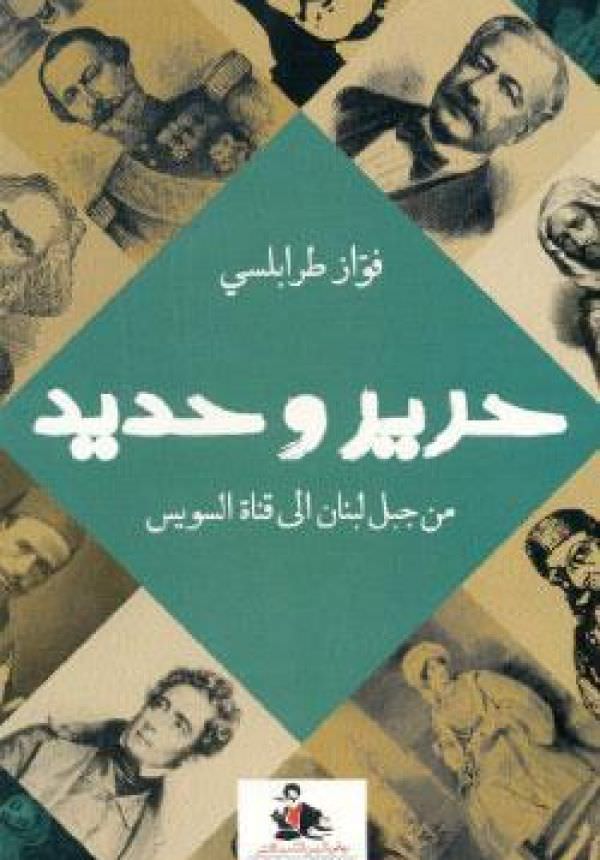
Silk and Iron: From Mount Lebanon to the Suez Canal
حرير وحديد: من جبل لبنان إلى قناة السويس
Guide to the Book
This guide to the book presents the book's chapters and main lines of argument based on its actual contents; it is not a literal reproduction of the printed table of contents. Silk and Iron is among Traboulsi's most inventive works — a narrative history that reconstructs the nineteenth century not as background to the twentieth but as a drama in its own right, following a cast of visionaries, adventurers, peasant rebels, utopian socialists, and colonial strategists whose paths converge on Mount Lebanon, Algeria, and the Suez Canal. The book's method is literary: it tells history through individuals whose lives illuminate structural forces. Its title comes from Emir Abdelkader's remark justifying his treaty with the French: "Man is made of silk and iron." The phrase captures the book's central tension — between commerce and conquest, civilisation and exploitation, prophecy and power.
1 Prophecies
- Pastoral scene
- 1806 — On the Spanish coast: Sir John Moore
- 1806 — London: Esther and the uncle (William Pitt)
- London: the prophecy
- March 1810 — Lady Hester Stanhope heads East
- 1810 — The road to Damascus
- Queen of the desert
- Four young men at 'Ayn Waraqa
- Palmyra: the lioness devours the lion
- Esther in the war of men
- 1821 — Commoners' revolt and breaking a tanbur
- "The nun of Mount Lebanon"
- 1824 — Rome: the Propaganda school
- 1825 — Paris: "The New Christianity"
- 1825 — The Lady and the Emir
- March 1826 — Qannubin: As'ad's heresy
- 1826 — Paris: "The Church of Work"
- 1826 — Alexandria: the first encounter
- The occupation of the fortress
The opening chapter introduces the book's principal method: history told through the intertwined lives of remarkable individuals. At its centre is Lady Hester Stanhope, niece of British Prime Minister William Pitt, who abandoned London for the Levant and became a self-proclaimed prophetess in the mountains of Lebanon. Around her orbit the young seminarians of 'Ayn Waraqa — including As'ad al-Shidyaq, whose conversion to Protestantism and subsequent persecution became a cause célèbre — and the early Saint-Simonians in Paris, who dreamed of a "New Christianity" that would reconcile East and West through industrial progress. The chapter weaves between London, Paris, Rome, and Mount Lebanon, establishing the web of prophecy, imperial ambition, and religious ferment that would shape the century. Stanhope's trajectory from political hostess to desert prophetess becomes a lens for examining how European fantasies about the Orient intersected with local realities of power, sect, and survival.
2 On Various Heresies
- As'ad al-Shidyaq and the American missionaries
- The heresy trial at Qannubin
- Saint-Simon's disciples and the call of the East
- The "Father" arrives in Egypt
- The plague and the canal dream
- Ahmad Faris al-Shidyaq: exile and transformation
The second chapter deepens the theme of heresy — religious, intellectual, and political. It follows As'ad al-Shidyaq's fatal encounter with American Protestant missionaries and his imprisonment by the Maronite patriarch, an episode that reveals the violent intolerance of ecclesiastical power when challenged by individual conscience. In parallel, the chapter traces the Saint-Simonian movement from Paris to Egypt, where Barthélemy Prosper Enfantin ("the Father") arrived with his disciples dreaming of piercing the Isthmus of Suez as a "nuptial" union of East and West. Their utopian mission collapsed amid plague and ridicule, but the canal idea survived them. Meanwhile, As'ad's brother Ahmad Faris al-Shidyaq began his own intellectual exile — from Lebanon to Egypt to Malta to Paris to Istanbul — becoming one of the most original Arabic writers of the century, a man who turned personal displacement into a radical critique of language, religion, and social convention.
3 On Opening and Closing Dormancy
- Bashir Shihab II and the Egyptian invasion
- Ibrahim Pasha's reforms in Mount Lebanon
- The conscription revolts
- British intelligence and the Druze
- The fall of Bashir II
The title, borrowed from the silk industry's vocabulary for the seasonal cycle of silkworm dormancy, signals a chapter about political awakening and suppression. Traboulsi narrates the Egyptian occupation of Syria (1831–1840) under Ibrahim Pasha and its contradictory effects on Mount Lebanon: equality before the law, tax reform, and modernised administration on one hand; forced conscription, weapons confiscation, and corvée labour on the other. The peasant revolts against conscription — uniting Druze and Christians for the first time — represent a moment of cross-sectarian solidarity that the chapter treats as historically significant precisely because it was so fragile. The fall of Emir Bashir Shihab II, who had allied with the Egyptians, opens a power vacuum that European powers — especially Britain and France — rush to fill, each cultivating its own sectarian clientele.
4 On Silk and Iron
- The voracious worm: silkworm biology and the labour of women
- 1837 — A truce with the Emir: Abdelkader in Algeria
- 1839 — Paris: digging canals and bridging gaps
- Madness: Lady Stanhope's decline and death
- 1840 — Saint-Simonian colonialism in Algeria
- 1840 — The silk of the Portalis brothers in Lebanon
- Colonial democracies: Tocqueville in Algeria
- Paris: the nephew and the uncle's ashes
- French women workers for Lebanese silk
- Mount Lebanon — Summer 1840: the anti-Egyptian revolt
The title chapter is the book's political-economic core. It opens with an extraordinary ethnographic account of silkworm cultivation — the biology of the worm, the labour of the women who tended it, the folk wisdom that governed the process — before revealing how this seemingly pastoral industry connected Mount Lebanon to Lyon, Marseille, and the circuits of global capital. The Portalis brothers, French silk industrialists, established the first modern reeling factory in Lebanon, importing machinery, French female workers, and capitalist labour relations into the Mountain. In parallel, the chapter follows Emir Abdelkader's resistance to the French conquest of Algeria and his famous remark that "man is made of silk and iron" — the phrase that gives the book its title. Tocqueville's writings on Algeria are examined as the intellectual architecture of liberal colonialism: democracy at home, racial domination abroad. The chapter braids together silk production, colonial conquest, utopian socialism, and peasant revolt into a single narrative of nineteenth-century globalisation.
5 Orientalizing — Occidentalizing
- The cocoon: from worm to silk thread
- The German Doctor in Brussels: Karl Marx
- 1847 — The Emir in captivity
- February 1848 — The Springtime of the Peoples
- The workers' insurrection
- In love with the people: Lamartine
- The German Doctor's springtime: The Communist Manifesto
- Prisoner of the springtime: Abdelkader in France
- Maronites to Algeria (2)
- 1848 — London in the time of revolutions: Faris al-Shidyaq
- 1850 — Maronites to Algeria (3)
This chapter takes its title from the double movement that defined the nineteenth century: Europe orientalising the East through fantasy and domination, and Eastern intellectuals occidentalising — selectively absorbing, resisting, and reinterpreting Western modernity. The 1848 revolutions serve as the pivot. Traboulsi follows Karl Marx in Brussels and London writing the Communist Manifesto, Alphonse de Lamartine leading the French provisional government, and Emir Abdelkader imprisoned in a French château — three figures representing three responses to the crisis of the old order. Meanwhile, Ahmad Faris al-Shidyaq arrives in London, discovers the misery of the English working class, and concludes that a state for workers and peasants would be safer than a state for the rich — arriving independently at socialist conclusions through direct observation rather than theoretical deduction. The repeated French schemes to settle Maronite peasants in Algeria reveal the colonial logic that treated populations as transferable labour reserves.
6 The Commoners' Revolt
- Dividing the harvest: the political economy of silk
- The 'ammiyya: the peasant uprising
- The patriarch's dilemma
- "The Pillar of Heaven" receives the news: Yusuf Karam
- The general agent: Tanyus Shahin
- The wife of Sha'ya 'Alman
- The muqasama movement: redistributing the land
- The amico and the governorship
This is the book's most vivid chapter — a microhistory of the Kisrawan peasant uprising of 1858–1859, told with the narrative intensity of a novel. Traboulsi reconstructs the world of the Maronite commoners ('ammiyya): the crushing burden of feudal dues, corvée labour, and humiliation at the hands of the mashayikh (notables); the silkworm economy that bound peasants to middlemen, usurers, and Lyon's commodity prices; and the explosive moment when the peasants, led by Tanyus Shahin, expelled the feudal lords from Kisrawan and established an elected council of commoners. The chapter includes remarkable dialogues — reconstructed from archival sources — between Shahin and his followers, capturing the spoken Arabic of nineteenth-century peasant politics. The women of the revolt appear not as bystanders but as participants who shamed wavering men into action. The patriarch's agonised attempts to mediate between feudal order and popular revolt reveal the structural contradictions of Maronite ecclesiastical power.
7 The Events of Sixty
- All silk roads lead to Lyon: the financial networks
- A traffic accident: the spark of 1860
- The Druze–Maronite war
- The Damascus massacre
- Emir Abdelkader protects the Christians
- Karl Marx on Syria and Lebanon
The "Events of Sixty" — the sectarian war of 1860 that devastated Mount Lebanon and culminated in the massacre of Christians in Damascus — is narrated by Traboulsi not as a religious explosion but as the violent outcome of structural transformations: the collapse of the feudal order, the penetration of European capital through the silk trade, and the competitive meddling of France and Britain through their respective sectarian clients. The chapter reveals how all silk roads led to Lyon, where financial networks controlled prices, credit, and ultimately the livelihoods of Lebanese peasants. A seemingly trivial traffic accident in Beit Meri — a quarrel between a Druze boy and a Christian boy over a donkey — ignites a conflagration that had been structurally prepared. The chapter's most striking juxtaposition places Emir Abdelkader, the Algerian resistance hero now exiled in Damascus, protecting Christians from massacre — while Karl Marx, writing from London for the New York Daily Tribune, analyses the events as a case study in how European powers manufactured sectarian conflict to justify intervention.
8 The Deal
- The cut: Ferdinand de Lesseps and the Suez Canal
- Beirut: cannons in the Burj square
- General Beaufort and the French expedition of 1860
- Security first: the intelligence apparatus
- The minister and the general
- The Beirut conference
- Trading a kingdom for a canal
- 14 June 1861: the Mutasarrifiya protocol
- 1861 — The intellectuals' trumpet: Butrus al-Bustani
- Maronites to Algeria (5)
The "deal" of the title is the grand bargain that ended the 1860 crisis and created the Mutasarrifiya — but Traboulsi reveals it as something larger: an exchange between Napoleon III's France and the Ottoman Empire in which the French abandoned their project for an independent Christian emirate in Lebanon in return for Ottoman permission to resume construction of the Suez Canal. The chapter follows Ferdinand de Lesseps's relentless lobbying, the French military expedition to Lebanon under General Beaufort d'Hautpoul (who built an intelligence network of 24 spies and 4 agents), and the five-power Beirut conference that settled Lebanon's fate. The creation of the Mutasarrifiya — an autonomous province under an Ottoman Christian governor — is presented as a compromise that satisfied none of the competing projects (Arab kingdom, Christian emirate, Ottoman centralisation) but established the sectarian power-sharing model that would endure. Meanwhile, Butrus al-Bustani launched his newspaper Nafir Suriyya, calling for secular citizenship and coexistence — the first articulation of civil nationalism in the Arabic-speaking world.
9 The Meeting of the Two Seas
- An emir and a canal: Abdelkader visits Lesseps
- 1867 — Youssef Bey Karam's revolt
- 17 November 1867 — The inauguration of the Suez Canal
- Karam and Abdelkader: two exiles compared
The title — marj al-bahrayn, a Quranic phrase for the place where two seas meet without mingling — serves as Traboulsi's metaphor for the Suez Canal's inauguration on 17 November 1869. The lavish ceremony at Port Said, attended by Empress Eugénie and heads of state, is the book's narrative climax: the moment when all the threads — silk and iron, prophecy and capital, Orient and Occident — converge. Emir Abdelkader sits beside the Emperor, a defeated resistance hero adorned with the Légion d'honneur, watching the canal that the Saint-Simonians had dreamed of and Lesseps had built. The chapter pairs his fate with that of Youssef Bey Karam, the Maronite hero who attempted an armed rebellion against the Mutasarrifiya in 1867 and was exiled by the French on a warship. Both men — the Algerian Muslim prince and the Lebanese Christian warrior — were sacrificed by France to its imperial calculations, each used as a reserve card and discarded when no longer needed.
10 Endings
- 1859 — Rifun: Tanyus Shahin's last years
- Paris, France — 1864: the Saint-Simonian's "bank of intellectual credit"
- Paris, France — 1869: death of the Poet of the Lake (Lamartine)
- Sedan, France — 19 July 1870: fall of the Second Empire
- 1881 — Egypt: the Khedive's debts and British occupation
- Damascus, Syria — 24 May 1883: death of Emir Abdelkader
- April 1884 — Ranzirna, Italy: Youssef Bey Karam's death
- Ahmad Faris al-Shidyaq: the end of a polyglot life
The final chapter traces the fates of the book's protagonists to their deaths — and through those deaths, the fate of the nineteenth century's competing projects. Tanyus Shahin, the peasant leader, died in obscurity in Rifun, his revolution absorbed and neutralised. The Saint-Simonian visionary spent his last years inventing a "bank of intellectual credit" that no banker would finance. Lamartine withdrew from public life and died forgotten. The Second Empire fell at Sedan, and Napoleon III was exiled to London. Britain bought Egypt's shares in the Suez Canal, and the Khedive's debts led to the 'Urabi revolt and British occupation — Egypt lost everything. Emir Abdelkader died in Damascus, a Freemason who edited Ibn 'Arabi's mystical writings while French agents monitored his every move. Youssef Bey Karam died a celibate mystic in Italy, having translated the life of Saint Catherine of Siena into Arabic. Ahmad Faris al-Shidyaq's portrait was confused with Tanyus Shahin's in a newspaper — a fitting coda for a book about the interchangeability of the century's outcasts. Each ending is a judgement on the promises and betrayals of modernity.
Back Matter
- Index of Names
- Index of Places