This opening volume provides the theoretical and methodological entry to History of Eastern Families, the encyclopedic project authored by Issa Iskandar al-Ma'louf and edited by Fawwaz Traboulsi. It explains the work’s sources and broad field, from Arab and eastern family origins to correspondence, oral history, and field research. Its importance lies in introducing the logic of the whole enterprise: genealogy here is not the vanity of notable families, but a tool for reading society, migration, power, and memory in the modern Mashriq.
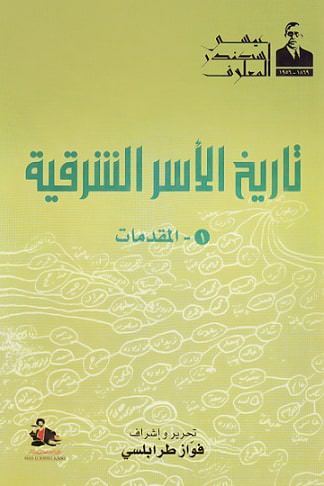
History of Eastern Families, Vol. 1: Introductions
تاريخ الأسر الشرقية ١ - المقدمات
Guide to the Book
This guide to the book presents the book's chapters and main lines of argument based on its actual contents; it is not a literal reproduction of the printed table of contents. The foundational volume of a seven-part encyclopaedia of Lebanese family histories, compiled over seventy years by the polymath scholar Issa Iskandar al-Maalouf (1869–1956) and edited posthumously by Fawwaz Traboulsi. This introductory volume provides the scholarly apparatus: Traboulsi's critical essay on genealogy and social history; al-Maalouf's own methodology and survey of ancient migrations; and a comprehensive reference section on the non-Arab peoples — European, Asian, Romani, Jewish — whose histories intersected with Levantine families, providing the civilisational context for the family-by-family histories in Volumes 2–7.
• Foreword (Fawwaz Traboulsi)
- How the manuscript came to be published ~50 years after al-Maalouf's death
- Evolution of the project from a family history (Dawani al-Qutuf) to a pan-Eastern encyclopaedia
- A theoretical essay on genealogy (nasab) drawing on Ibn Khaldun
- The dialectic of origins vs. migration; social functions of genealogy (asabiyya, marriage alliances, inheritance)
- Six key distinctions of the work: inclusiveness, Arab origins of Christian families, north-to-south migration, sectarian identity changes, methodological innovation
- Editorial principles used in preparing the manuscript
Traboulsi's critical introduction, written in Beirut, September 2006. He frames al-Maalouf's genealogical enterprise within the social history of late Ottoman Greater Syria, arguing that genealogy served as the language through which communities negotiated identity, property, and political allegiance during the profound transformations of the 19th century.
• Preface (Riyad al-Maalouf)
- Personal tribute to the author's seventy-year labour
- Scholars and institutions who attempted to help publish: Jacques Berque (Sorbonne), Philip Hitti (Princeton), Library of Congress
- Eulogies from Amin Nakhle, Mikhail Naimy, Fouad al-Boustani, Sheikh Suleiman al-Zahir, Fares al-Khoury
Written by the author's son, the poet Riyad al-Maalouf, from Zahleh in March 1982. A portrait of a scholar who devoted his entire life to a single monumental work that he never saw published.
• The Scholar Issa Iskandar al-Maalouf: His Life and Works
- Birth in Kfaraqab (1869); education and career as teacher and journalist (newspaper Lubnan in Baabda)
- Membership in the Arab Scientific Academy (Damascus), Academy of the Arabic Language (Cairo)
- Published works — 19+ printed books including Dawani al-Qutuf, Tarikh Zahleh, Tarikh al-Amir Fakhr al-Din
- Unpublished manuscripts — 60+ works including the 14-volume Akhbar al-Usar, dictionaries, regional histories
- His library — 2,000+ manuscripts in Arabic, Syriac, Hebrew, Turkish, Persian, Coptic, and European languages
Biographical essay covering al-Maalouf's extraordinary output: a journalist, historian, lexicographer, and member of multiple national academies who produced over 80 works — most still unpublished — spanning the history, genealogy, linguistics, and folklore of Greater Syria.
• Preamble & Prolegomenon (Issa Iskandar al-Maalouf)
- Preamble — Motivation, 30+ years of material collection, appeals through newspapers for family information
- Prolegomenon: "Origins of Families" — Definitions of nasab (genealogy) and its purpose
- "A Word on Families and Their Dispersal" — Migration as old as humanity; causes: livelihood, disasters, persecution, wars, slavery, conquest
- "The Earliest Displaced Peoples" — Ancient migrations: Canaanites, Hebrews, Phoenicians to Carthage, the breaking of the Ma'rib Dam and dispersal of Yemeni tribes
Al-Maalouf's own introduction: a theoretical essay on the universality of migration and genealogy, drawing on classical Arabic sources (Said ibn Batriq, Shams al-Din al-Dimashqi) to trace the deep history of human dispersal from antiquity to the present.
Part I — Origins and Ancestries
1 Origins of Ancient Nations
- The three sons of Noah: Shem, Ham, Japheth — Semitic, Hamitic, and Japhetic peoples
- Key peoples of Greater Syria: Aramaeans, Canaanites, Phoenicians, Hebrews, Philistines, Hittites
- Their interrelations, migrations, and the Table of Nations from Genesis
A survey of the ancient peoples of the Levant through the lens of biblical genealogy and classical historiography, mapping the ethnic mosaic from which the region's later families would claim descent.
2 Peoples of Europe
- The Albanians — Origins, language (Shqiptar), Albanian communities in Syria/Lebanon, the Arnaut military settlers
- Al-Andalus — Muslim Spain, the Reconquista, Andalusian families who migrated to North Africa and the Levant
- The Portuguese and Dutch — Eastern trade and colonial presence
- Cyprus — Lusignan and Venetian rule, connections to Levantine families
- Crete (Aqritash) — Arab conquest, Cretan refugees in the Levant
- Corfu — History and Eastern connections
- The French in the East — Crusaders, Frankish settlers, French cultural influence
- Muslims in Europe — Muslim communities across European countries
A survey of European peoples with historical ties to the Levant — from Albanian military settlers and Andalusian refugees to Crusader Franks and Cretan migrants — providing the genealogical context for Levantine families claiming European origins.
3 Peoples of Asia
- The Turks — Origins, tribal divisions, Ottoman dynasty, Turkish settlement in Syria, Turkmen tribes and genealogies
- The Circassians in Syria — Mass migration after the Russo-Circassian wars, settlement in Syria, Jordan, Palestine
- The Kurds — Origins, Kurdish tribes, settlements across the Levant, the Ayyubid dynasty
- India — Indian connections to the Arab world, trade routes, Indian communities
- Syriac Families — Syriac/Assyrian Christian communities, ecclesiastical traditions, prominent families
The Asian peoples whose migrations reshaped the Levant: Turks and Turkmen who arrived with the Ottoman conquest, Circassians displaced by Russian expansion, Kurds whose tribal networks spanned from Mesopotamia to Mount Lebanon, and the ancient Syriac Christian communities.
4 Ranks of Arab Genealogies
- Three classes of Arab lineage: extinct Arabs (al-ʿArab al-Bāʾida), pure Arabs/Qahtanites (al-ʿArab al-ʿĀriba), Arabised Arabs/Adnanites (al-ʿArab al-Mustaʿriba)
- Genealogical trees from Qahtan and Adnan; major tribal confederations and their migrations
- Qurayshite families in Greater Syria — Families claiming descent from the Prophet's tribe; Hashemites, Husayni and Hasani lineages; the Naqib al-Ashraf institution
The core genealogical framework: al-Maalouf maps the traditional Arab system of lineage classification, from the "extinct" pre-Islamic Arabs through the Qahtanite/Adnanite division to the Qurayshite families who settled across Greater Syria — the Sharifs and Sayyids whose descent from the Prophet conferred both prestige and political authority.
5 The Nawar (Romani)
- Origins of the Nawar — Aryan/Indian origin theories
- Dispersal across the Middle East and Europe; customs, occupations, social organisation
- Language analysis — Romani vocabulary compared to Hindi/Sanskrit
- The Nawar in Syria, Lebanon, Egypt, and across Europe (Spain, Hungary, Romania, Russia, England, France)
- Songs of the Nawar/Gitanos in Andalusia — Flamenco traditions
- Bibliography of works on the Romani (Arab and European authors)
An extensive monograph on the Romani people — one of al-Maalouf's most original contributions. He traces their Indian origins, analyses their language, documents their presence across the Middle East and Europe, and devotes special attention to the Flamenco traditions of the Spanish Gitanos.
6 The Jews in the World: A General Historical Study
- Jews: their dispersal and genealogies — from ancient Israel through the diaspora
- Jewish communities across the Middle East: Damascus, Baghdad, Aleppo, Jerusalem, Hebron, Safed
- Jews in the world: population statistics by country
- Jews in European capitals
- Notable Jewish families of the Levant and Iraq
A historical survey of Jewish communities, from the ancient dispersal to the early 20th-century demographics. Al-Maalouf documents the major Jewish communities of the Middle East — Damascus, Baghdad, Aleppo — and provides population statistics that capture a world on the eve of its transformation.
Back Matter
- Index of Names
- Index of Places
Notes
Vol 1 of 7. Original author: عيسى إسكندر المعلوف (1869-1956). Verified (تحقيق) by فواز طرابلسي. First edition, hardcover, 24×17cm.