This first edition of Fawwaz Traboulsi’s testimony on Dhofar preserves an early voice written in very close proximity to the revolutionary experience itself. It returns to the years of beginnings, when the revolution was still an open horizon, struggling to balance armed struggle, organization, and social transformation. The book’s value lies precisely in that immediacy: it is not a later reassessment, but a record of Dhofar as it was being lived and thought in its own present.
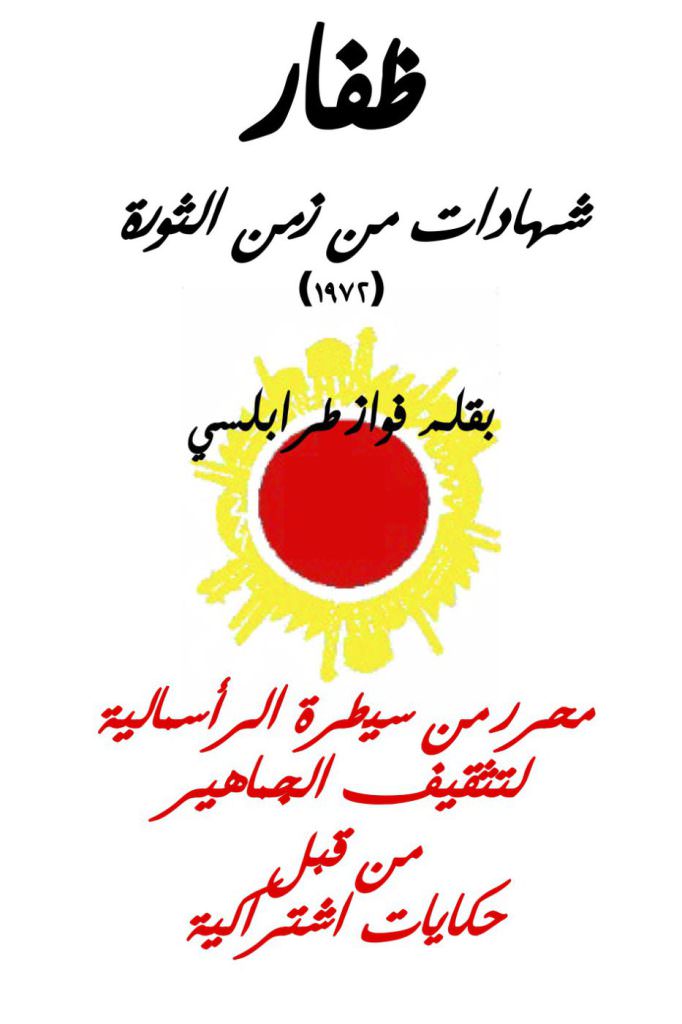
Dhofar: Testimonies from the Time of Revolution
ظفار: شهادات من زمن الثورة
Guide to the Book
This guide to the book presents the book's chapters and main lines of argument based on its actual contents; it is not a literal reproduction of the printed table of contents. Written when Traboulsi was twenty-nine, based on his February 1970 visit to the liberated zones of Dhofar with British journalist Fred Halliday, this book is one of the rarest first-hand accounts of the Dhofar Revolution — the most radical armed liberation movement in the modern Arab world. The text was controversial from the start: the revolution's leadership objected to Traboulsi's analysis of tribal structures, and the Beirut journal al-Hurriya, where sections had been serialised, was banned by the Front's order. Traboulsi chose to publish the manuscript unchanged, as a contribution to the historical record of a revolution that few outside observers had documented.
1 Colonialism in Oman and the Arabian Gulf
- The Batina and the Interior: two Omans
- The Al Bu Said dynasty and British control
- Protection treaties and the colonial framework
- The oil economy and its consequences (1920–1968)
- Institutions of colonial control
- The Sultan's armed forces: a British army
- Oil monopolies and the Gulf
The opening chapter is not about Dhofar at all — it is a structural history of British colonialism in Oman and the Arabian Gulf. Traboulsi reconstructs over a century of British imperial control, from the earliest protection treaties with Gulf sheikhdoms to the oil economy of the 1960s. He demonstrates that Britain's domination operated through a distinctive system: indirect rule via compliant sultans, sheikhs, and emirs, maintained by a network of political residents and agents, backed when necessary by direct military force. The chapter documents how Britain intervened over 27 times between 1800 and 1950 to maintain the Al Bu Said dynasty on the throne in Muscat — bombarding coastal towns, deposing uncooperative rulers, and imposing treaties that surrendered sovereignty over foreign affairs, defence, and resource extraction. The oil economy, when it arrived, deepened rather than loosened colonial control: oil concessions were granted exclusively to British companies, revenues were managed by British advisors, and the Sultan's armed forces were commanded by seconded and contracted British officers — many veterans of counterinsurgency campaigns in Malaya, Cyprus, and East Africa.
2 The "Subjecthood" of Dhofar
- Dhofar's tribal history and the Sultanate's control
- The rule of Sultan Said bin Taimur in Salalah
- Economic strangulation: taxes, monopolies, and deliberate underdevelopment
- The hostage system and tribal manipulation
- Emigration to the Gulf and the oil prospectors
- 9 June 1965: the launch of the armed struggle
This chapter is a devastating portrait of Sultan Said bin Taimur's rule over Dhofar — a system that a United Nations committee described as treating the population "like slaves." Traboulsi documents a regime of systematic oppression: no schools (except one in Salalah reserved for the Sultan's servants), no hospitals, no economic development, a ban on travel, construction, radio ownership, bicycle riding, football, smoking, wearing shoes, and even wearing trousers. The economic system rested on three pillars: the deliberate isolation of Dhofar from any modernising influence; the conscious blocking of any economic development that might empower the population; and the extraction of surplus through punishing taxes on every economic activity from fishing to animal husbandry. The political system operated through hostage-taking and the calculated exploitation of tribal divisions. The chapter demonstrates that the armed struggle launched on 9 June 1965 was the inevitable product of these conditions — catalysed by two factors: emigration to the Gulf, where Dhofaris encountered the Arab nationalist movement, and the discovery of oil, which convinced them that the Sultan intended to profit from their land while denying them any benefit.
3 The Armed Struggle in Dhofar: Difficult Beginnings
- The Dhofar Liberation Front
- Arab nationalist thought and secessionist tendencies
- The first phase of armed struggle (1965–1968)
- The relationship with South Yemen and the UAR
- The tension between nationalist and secessionist currents
Traboulsi reconstructs the difficult first years of the armed struggle — a period when a handful of poorly armed fighters, lacking modern weapons and secure supply lines, faced annihilation more than once in the mountains of Dhofar. The chapter traces the formation of the Dhofar Liberation Front in late 1964, its composition (Gulf emigrants and rural tribal elements), and the ideological tension between two currents: an Arab nationalist current that saw the struggle as part of the broader Arab liberation movement, and a secessionist tendency that wanted to liberate Dhofar from Muscat's rule without necessarily connecting to the wider regional struggle. This tension — between localism and pan-Arabism, between tribal identity and revolutionary universalism — was never fully resolved in the first phase. Traboulsi analyses the Front's founding declaration of 9 June 1965 with characteristic precision, showing how the secessionist position hid behind Arab nationalist rhetoric without ever clearly defining the relationship between Dhofar and the rest of the Sultanate. The political developments in South Yemen — particularly the revolution of 14 October 1963 — were decisive in tilting the balance toward the revolutionary current.
4 The Great Turn: The Popular Front
- The Hamrin Congress (September 1968)
- The National Charter: a critical review
- Transformation into the Popular Front for the Liberation of the Occupied Arab Gulf
- The military situation: liberation of the Western Zone
- The British officer's testimony: "The Unknown War"
- The coup against Sultan Said bin Taimur (July 1970)
The "great turn" of the title is the Hamrin Congress of September 1968, which transformed the Dhofar Liberation Front into the Popular Front for the Liberation of the Occupied Arab Gulf — adopting Marxism-Leninism as its ideology, renaming the armed forces the People's Liberation Army, establishing democratic centralism, committing to women's equality and the abolition of slavery, and expanding the revolution's horizon from Dhofar to the entire Gulf. The chapter reconstructs the Congress's National Charter in detail — a document that Traboulsi considers the Front's most important text because it defined the revolution as a class struggle against imperialism, feudalism, and the comprador bourgeoisie. The military narrative is equally compelling: by mid-1970, the People's Liberation Army controlled three-quarters of Dhofar, having liberated the entire Western Zone. The chapter includes the remarkable testimony of a British officer, Captain Hubert Stinton, who served with the Sultan's forces and described the war in Dhofar as one where "almost every Dhofari now stands with the rebels." The chapter culminates with the British-orchestrated coup of 23 July 1970 that deposed Sultan Said bin Taimur and installed his son Qaboos — inaugurating a new phase of neocolonial counterrevolution.
5 Life in the Liberated Zones
- Arrival in the Western Zone: from Hauf to Rakhyut
- Why they fight: interviews with fighters
- Marxism reaches Dhofar: Mao Zedong and revolutionary consciousness
- Women's liberation — society's liberation
- Women's contribution to the armed struggle
- Amina and Tuful: two women fighters
- Developing production in the liberated zones
- Agricultural cooperatives and land reform
- The "Committee for Solving the People's Problems"
- Abolition of the mahr (bride price)
- Control over the "producer of the producer": women and reproduction
This is the book's most extraordinary chapter — a first-hand account of daily life in the liberated zones of Dhofar, based on Traboulsi's two-week visit in February 1970. He and Fred Halliday travelled by armed boat from South Yemen, slept in mountain caves, shared the fighters' meagre rations of corn bread, milk, and tea, and witnessed a society in the process of revolutionary transformation. The chapter includes remarkable interviews with fighters — oil workers, fishermen, pearl divers, shepherds, and former slaves — who explain why they joined the revolution. Two interviews with women fighters, Amina and Tuful, are among the most powerful passages in all of Traboulsi's writing. The chapter analyses the Front's programme of social transformation: land redistribution through agricultural cooperatives, literacy campaigns (where the alphabet itself became a tool of political education — the first words students learned were "class, society, struggle, freedom, revolutionary"), the "Committee for Solving the People's Problems" (a mobile court that settled tribal disputes and enforced the ban on blood feuds), and most radically, the abolition of the mahr (bride price) — which Traboulsi argues was not merely a women's rights measure but the destruction of the material basis of tribal patriarchal authority, since the mahr system functioned as the mechanism through which elders controlled young men's labour and women's reproductive capacity.
6 Two Paths: Neo-colonialism or National Democratic Revolution
- The neocolonial modernisation under Qaboos
- The Iranian occupation of the Tunb islands
- Qaboos bin Said: "the son surpassed his father"
- The Anglo-American rivalry in Oman and the Gulf
- The creation of the United Arab Emirates
- Counter-revolution on multiple fronts
- British military operations against the revolution
The final chapter confronts the revolution's future by analysing the two paths open to Oman and the Gulf: neocolonial modernisation under Sultan Qaboos (installed by the British coup of July 1970) or national democratic revolution led by the Popular Front. Traboulsi describes Qaboos as "the son who surpassed his father" — not in cruelty but in the sophistication of his neocolonial arrangement. Where Said bin Taimur had ruled through naked repression and deliberate stagnation, Qaboos offered a modernising facade: schools, hospitals, roads, and a constitution — all while British officers continued to command the army, Shell controlled the oil, and the new Sultan's sovereignty remained as circumscribed as his father's. The chapter analyses the Anglo-American rivalry in the Gulf following Britain's partial withdrawal east of Suez, the creation of the United Arab Emirates as an arena of competing colonial influences, and the counter-revolutionary military campaigns — including "Operation Leopard" (October–December 1971), in which British regular forces, SAS commandos, and Jordanian advisors launched a major offensive against the liberated zones. Traboulsi closes with a stark geopolitical assessment: the revolution in Dhofar would succeed or fail depending on whether it could link its struggle to the broader national movements in Oman and the Gulf before the combined forces of British, American, Saudi, and Iranian counterrevolution could crush it.
Back Matter
- Appendix 1: The Declaration of the Armed Struggle (9 June 1965)
- Appendix 2: The Hamrin Congress National Charter (September 1968)
- Appendix 3: The Political Programme of the Popular Front
- Index of Names
- Index of Places
Notes
First edition, 1972. Republished in 2004 by Riyad El-Rayyes Books, Beirut, with a new introduction.