This book offers a broad synthesis of modern Lebanese history from the emirate to the Taif Agreement without treating sectarianism as destiny or separating politics from its social economy. Fawwaz Traboulsi links state formation to countryside and city, labor and migration, and regional intervention, rewriting the national story from below and from within its contradictions. It has become a standard reference for anyone seeking to understand modern Lebanon beyond the myth of "exceptionalism." This second updated edition (2012) includes a new chapter covering events from the Cedar Revolution and the 2006 war through the upheavals of the Arab Spring, along with updates and revisions throughout.
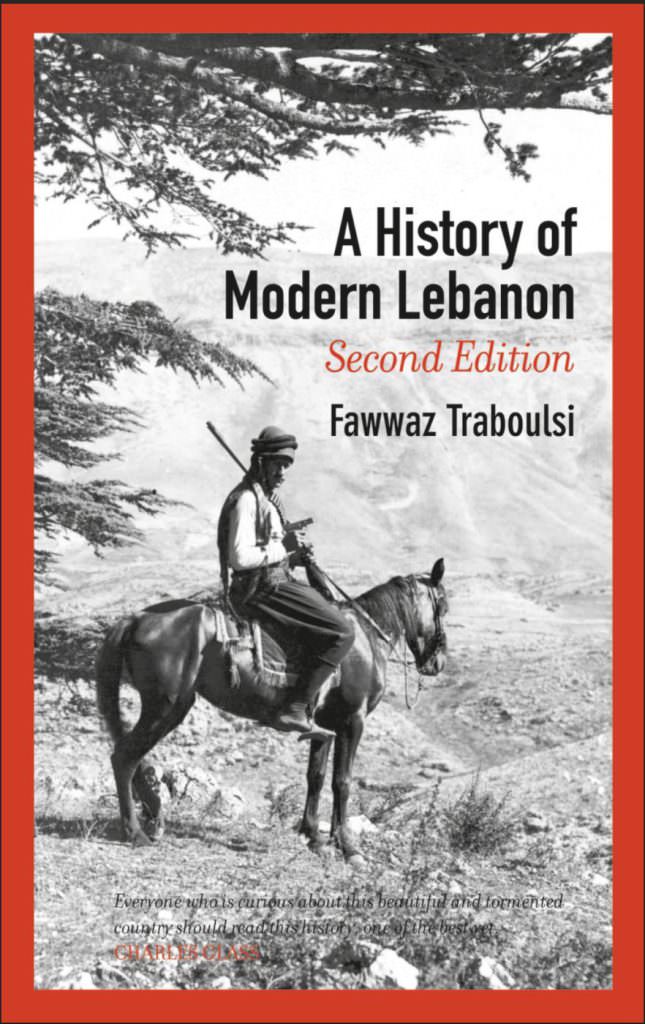
A History of Modern Lebanon (Second Edition)
Guide to the Book
This guide to the book presents the book's chapters and main lines of argument based on its actual contents; it is not a literal reproduction of the printed table of contents. Traboulsi opens by identifying three interlocking threads that run through the entire book: the political construction and reproduction of sectarianism, the character of Lebanon's liberal economy and its relationship to social inequality, and the country's position within shifting regional and international power structures. The preface makes clear that this is not a neutral chronicle but an interpretive history — one that insists sectarianism is not a cultural given but a political instrument, and that Lebanon's crises cannot be understood apart from the political economy that generates them.
Part I — Ottoman Lebanon
1 Emirate and Mutasarrifiya (1516–1918)
- The Emirate of Mount Lebanon
- The iqta' system
- Bashir Shihab II and the Egyptian Invasion
- 1840–1860: Peasant revolts and religious strife
- The Mutasarrifiya of Mount Lebanon (1861–1915)
This opening chapter establishes the deep structure of Lebanese political life across four centuries of Ottoman rule. Traboulsi traces the Ma'n and Shihab dynasties' consolidation of power through the iqta' (tax-farming) system, showing how feudal authority rested on a delicate balance between Druze and Maronite notables rather than on religious identity as such. The chapter's pivot comes with Bashir Shihab II, whose alliance with Muhammad Ali's Egyptian invasion (1831–1840) broke the old equilibrium and opened Mount Lebanon to direct European intervention. The bloody sectarian conflicts of 1840–1860 — culminating in the massacre of Christians in Damascus and Druze–Maronite warfare in the Mountain — are presented not as expressions of ancient hatreds but as the violent consequences of a collapsing feudal order under pressure from peasant revolt, foreign interference, and Ottoman reform. The Mutasarrifiya (1861–1915), an internationally guaranteed autonomous province, institutionalised sectarian representation for the first time, creating the template that would define Lebanese politics ever after.
2 The Silk Industry (1516–1914)
- Silk production and the Lebanese economy
- European penetration and the transformation of agriculture
- Social classes in Mount Lebanon
- The workers of the silk industry
Traboulsi devotes an entire chapter to silk production because he sees it as the key to understanding Lebanon's insertion into the world economy — and the social transformations that followed. From the sixteenth century onward, Mount Lebanon became a supplier of raw silk to European, especially French, manufacturers. By the nineteenth century, this trade had restructured rural society: a class of merchant intermediaries emerged between European buyers and peasant producers, land tenure patterns shifted, and a nascent proletariat of silk-reeling workers — overwhelmingly women and children — appeared in the factories of the Mountain. The chapter demonstrates how economic dependency on a single export commodity, controlled by foreign capital, created the structural vulnerability and class stratification that would persist long after silk itself declined.
3 Culture and the Nahda (1800–1918)
- Missionaries and education
- The Nahda: an Arab Renaissance?
- The press and public opinion
- Lebanese and Arab identities
The third chapter examines the cultural and intellectual ferment of the nineteenth century — the Nahda, or Arab Renaissance — and its particular Lebanese inflections. Traboulsi traces how the arrival of American Protestant and French Catholic missionaries transformed education, creating a network of schools and printing presses that produced a new literate public. But this cultural awakening was not monolithic: it generated competing visions of identity. Some intellectuals championed an Arab cultural and political identity; others articulated a specifically Lebanese one, rooted in Phoenician heritage and Christian particularity. The chapter is attentive to the class dimension of these debates, noting that the emerging bourgeoisie and intelligentsia had material interests in one orientation or another depending on their economic ties to Europe or the Arab interior.
4 The First World War and Its Aftermath
- Lebanon in the Great War: famine and resistance
- The Arab Revolt and the Sykes-Picot Agreement
- Aspirations and frustrations at the end of the war
The Great War was catastrophic for Mount Lebanon. Traboulsi documents the famine of 1915–1918, in which an estimated one-third of the population perished — the result of an Allied naval blockade, Ottoman requisitioning, a locust plague, and the indifference of the authorities. The chapter then follows the contradictory promises made by the European powers: the Husayn–McMahon correspondence, the Sykes-Picot Agreement, and the Balfour Declaration, each laying claim to overlapping territories and making incompatible commitments to Arab, Zionist, and imperial interests. The war's aftermath left Lebanese political actors divided between those who sought integration into Faysal's Arab Kingdom in Damascus and those — primarily Maronite elites — who lobbied for a French-protected Greater Lebanon.
Part II — State and Society
5 Greater Lebanon: The Dialectics of Attachment and Detachment (1915–1920)
- The Greater Lebanon project
- The four annexed regions
- Social and economic consequences of expansion
The proclamation of Greater Lebanon on 1 September 1920 is treated by Traboulsi as one of the most consequential and contradictory acts of state creation in modern Middle Eastern history. The new entity annexed to the old Mutasarrifiya four predominantly Muslim regions — the Biqa' valley, Tripoli and the north, Sidon and the south, and Beirut — whose populations had not been consulted and many of whom favoured union with Syria. The result was a state that was larger and economically more viable than the Mountain alone, but one in which the Maronite demographic majority that had justified the original autonomy no longer existed. Traboulsi frames this as a structural dilemma: Greater Lebanon was too large to be a Christian homeland and too small to be a viable national state without the consent of its Muslim citizens.
6 From Mandate to Independence (1920–1943)
- The French Mandate and its institutions
- The Constitution of 1926
- Economic policies under the Mandate
- Social transformations and political movements
- The road to independence: the National Pact of 1943
This chapter covers the quarter-century of French Mandate rule, tracing how colonial administration simultaneously built the institutions of the Lebanese state and ensured its subordination to French interests. The Constitution of 1926 established a parliamentary republic, but the High Commissioner retained the power to suspend it — which he did repeatedly. Traboulsi follows the social movements and political currents — from labour strikes to the emergence of cross-sectarian parties like the Syrian Social Nationalist Party and the Lebanese Communist Party — that challenged both French authority and the sectarian system. It culminates in the National Pact of 1943, the unwritten agreement between Bechara El Khoury and Riad al-Solh that traded Muslim acceptance of an independent Lebanon for Christian renunciation of Western protection. Traboulsi presents the Pact not as a moment of genuine national consensus but as a pragmatic arrangement between two elite factions, each calculating its advantage in the shadow of retreating French power.
7 The Merchant Republic (1943–1952)
- Laissez-faire and the commercial economy
- The Khoury regime and clientelism
- The SSNP coup attempt and the Rosewater Revolution
Independent Lebanon's first decade is characterised by Traboulsi as the consolidation of a "merchant republic" — a state whose institutions served the interests of Beirut's commercial and financial bourgeoisie. Under President Bechara El Khoury, patronage networks flourished, monopolies were distributed among allies, and the economy was organised around the principle of laissez-faire: minimal regulation, low taxes, free capital movement, and a services-oriented model that made Lebanon a financial intermediary between the West and the oil-producing Arab states. Khoury's overreach — including a constitutional amendment to extend his own mandate — provoked the "Rosewater Revolution" of 1952, a general strike led by a cross-sectarian opposition that forced his resignation. Yet the revolution changed the president without changing the system.
8 The Pro-Western Authoritarianism of Camille Chamoun (1952–1958)
- Chamoun and the Cold War
- The Eisenhower Doctrine
- The 1958 crisis and American intervention
Camille Chamoun's presidency aligned Lebanon with the Western camp in the Cold War more explicitly than any of his predecessors. His embrace of the Eisenhower Doctrine and his hostility to Nasserism alienated large segments of the Muslim population, who saw in Nasser's pan-Arab project a challenge to the confessional order that marginalised them. The 1958 crisis — a brief armed insurrection that combined Muslim discontent, pan-Arab enthusiasm, and opposition to Chamoun's attempt to renew his mandate — ended with the landing of US Marines on Beirut's beaches, the first direct American military intervention in the Middle East. Traboulsi presents the crisis not as a religious civil war but as a political conflict over Lebanon's regional orientation and the distribution of power within the confessional system.
9 Shihabism and the Difficult Autonomy of the State (1958–1970)
- Fuad Chehab's reform project
- The Deuxième Bureau and state-building
- Social and economic reforms
- The limits of Shihabism
- Charles Helou: Shihabism without Shihab
Shihabism represents, in Traboulsi's reading, the most sustained attempt to build an autonomous state apparatus in Lebanon's history — and its failure reveals the structural limits of reform within the confessional system. Fuad Chehab modernised the bureaucracy, created institutions of social welfare and economic planning, expanded the state's reach into neglected peripheral regions, and used the military intelligence apparatus — the Deuxième Bureau — to manage political life. Yet Chehab's reforms stopped short of challenging the fundamental prerogatives of the sectarian elite: the confessional distribution of power, the dominance of the commercial bourgeoisie, and the laissez-faire economic model. By the late 1960s, Shihabism had exhausted itself — unable to satisfy the rising demands of workers, students, and the Left, yet having antagonised the traditional notables enough to provoke their return.
10 From Social Crisis to Civil War (1968–1975)
- The crisis of the rentier state
- A dissociated representative system
- Aborted 'revolution from above'
- The army: for internal control or national defence?
- Beirut, capital of Arab culture
- Slippages and divisions
- Renewal and contestation in the religious institutions
- Moussa Sadr and the Shi'i awakening
- Displaced frustrations
This is the book's longest and most analytically dense chapter, functioning as the hinge between the history of the republic and the history of the war. Traboulsi assembles a multi-layered account of the crisis: the failure of the rentier economy to absorb its growing population; a representative system so disconnected from social reality that political dynasties held 245 of 425 parliamentary seats since 1920; the aborted "revolution from above" under Suleiman Frangieh, in which every attempt at reform was blocked by the commercial oligarchy; and an army designed for internal repression rather than national defence. Alongside this political analysis, the chapter offers a vivid portrait of Beirut as the capital of Arab culture in the 1960s — home to the poets of Shi'r magazine, the publishers of Dar al-Tali'a and Dar al-Adab, the Ba'albak Festival, and a generation of intellectuals from Adonis and Nizar Qabbani to Ghassan Kanafani and Mahmoud Darwish. The chapter then traces the rise of Moussa Sadr and the Shi'i political awakening, the displaced frustrations of a society where reform was blocked at every turn, and the escalating confrontation that culminated in the 'Ayn al-Rummaneh bus massacre of 13 April 1975.
Part III — The Wars of Lebanon
11 Reform by Arms (1975–1976)
- Security or reforms?
- Secularism and the 'abolition of sectarianism'
- Military escalation
- The Syrian–Israeli 'deterrent dialogue'
- The race between Arab mediation and military victory
- Paradoxes and illusions of the LNM–PLO alliance
Traboulsi frames the first phase of the war as a battle over reform — not simply a sectarian bloodletting. The Lebanese National Movement, led by Kamal Jumblatt, allied with the Palestine Liberation Organization and issued a programme calling for the abolition of political sectarianism, a secular personal status code, proportional representation, and administrative decentralisation. The Kataeb Party and its allies in the Lebanese Front fought not only against the Palestinian armed presence but against any structural reform that would dilute Maronite political privilege. The chapter tracks the military escalation — from the Battle of the Hotels to the fall of Karantina and the siege of Tall al-Za'tar — while simultaneously following the diplomatic manoeuvres that brought Syria into the war. Traboulsi reveals how the Syrian–Israeli "deterrent dialogue," brokered by Kissinger, established the "red lines" that would govern external intervention in Lebanon for years to come. The chapter's most penetrating section analyses the paradoxes of the LNM–PLO alliance: each partner needed the other's military force, but their strategic objectives — political reform for one, armed struggle against Israel for the other — were never fully aligned. The assassination of Kamal Jumblatt in March 1977 closed this phase.
12 The Longest Coup d'état (1977–1982)
- Breakup of the tripartite alliance
- The security dream of Elias Sarkis
- The resistible rise of Bashir Gemayel
- 'Operation Peace for Galilee'
- 23 days of an aborted coup d'état
The second phase of the war is recast by Traboulsi as a protracted seizure of power — a coup d'état in slow motion. The chapter traces the collapse of the tripartite alliance between Syria, President Elias Sarkis, and the Kataeb Party, driven apart by the Camp David Accords, the Israeli counter-offensive in Lebanon, and the Phalange's deepening relationship with Israel. At its centre is the "resistible rise" of Bashir Gemayel, who unified the Christian militias through violence — eliminating rival leaders, imposing his authority on the north through the Ihdin massacre, and building a proto-state in the Christian enclave funded by Israeli arms and Lebanese port revenues. The chapter climaxes with the Israeli invasion of June 1982, which Traboulsi presents as the military instrument of Bashir's political project. Bashir's assassination on 14 September 1982 — and the Sabra and Shatila massacres that followed, carried out by Lebanese Forces units under Israeli cover — ended the project but not its consequences.
13 The War Order (1983–1990)
- Amine Gemayel and the Phalangist state
- Some negotiate, others resist
- Progression of the Syrian counter-offensive
- The economic debacle
- Return of the Syrian forces
- The reproduction of armed sects
- The political economy of militia control
- Cantons and ports: a new configuration of space
- Marginalisation of the state
- Sectarian division and purification
- Pillage, piracy and plunder
- Tribute and protection money
- Militias as business enterprises
- War and social mobility
- War as demographic purge
This is Traboulsi's most original analytical contribution to the historiography of the Lebanese war. Rather than narrating events chronologically, he dissects the "war order" as a political-economic system in its own right — a new mode of social organisation that replaced the prewar state. The chapter documents how the militias became simultaneously armies, governments, and business enterprises: they levied taxes, ran ports, controlled imports, operated television stations, and collected tribute at armed checkpoints. The war produced not chaos but a new configuration of power: a dozen armed cantons, each with its own port, tax system, and sectarian constituency. The state was marginalised to the point of irrelevance — robbed of its revenues, its monopoly on violence, and its territorial integrity. The chapter's most powerful sections analyse the war as a machine of demographic purge: 71,328 killed, 157,500 Muslims and 670,000 Christians displaced, and nearly a third of the population driven into emigration. Sectarian "cleansing" was not incidental to the war; it was one of its primary functions.
14 Ambiguities and Contradictions of the Ta'if Agreement
- The Ta'if Agreement and the end of the war
- Constitutional reforms and power redistribution
- The Syrian role in postwar Lebanon
The final chapter examines how the war ended — not with a victorious settlement but with an exhausted compromise. The Ta'if Agreement of October 1989, negotiated by Lebanese parliamentarians in Saudi Arabia under Syrian–American sponsorship, modified the confessional system without abolishing it: Christian–Muslim parity replaced the old 6:5 ratio in Parliament, the president's powers were curtailed in favour of the prime minister and speaker, and sectarian quotas were removed from civil service posts below the top grade. But the promised council for the abolition of sectarianism was never created, and Syrian military and intelligence dominance — formalised in the Brotherhood Agreement of 1991 — became the real guarantor of postwar stability. The Ta'if order did end the armed conflicts, but it reproduced the sectarian system in a new configuration of power — one in which the warlords became the statesmen and the structural problems that had caused the war remained unresolved.
Back Matter
- Chronology (634 CE – 2007)
- Glossary of Arabic and specialist terms
- Notes
- Select Bibliography
- Index
Notes
Second updated edition with new chapter and updates throughout. Also available in open access through Pluto/OAPEN. Paperback: 978-0-7453-3274-1; Hardcover: 978-0-7453-3275-8; eBook: 978-1-8496-4729-8. Additional digital ISBNs: 978-1-8496-4728-1, 978-1-8496-4730-4.