This book dismantles one of the most overused expressions in modern Arab political culture: “Sykes-Picot.” But it refuses to reduce regional history to a line on a map, which is why “Balfour” enters the title and the argument moves beyond cartography itself. Here Fawwaz Traboulsi reads war, empire, oil, mandate rule, and Palestine as intertwined elements in the making of the modern Mashriq, proposing an account of partition as a long political, military, and social process rather than a single secret agreement.
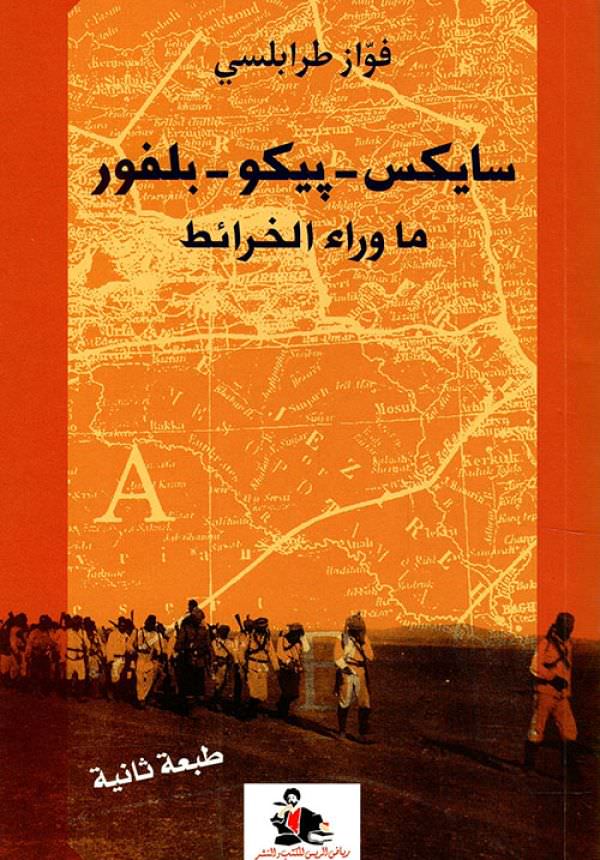
Sykes-Picot-Balfour: Beyond the Maps
سايكس - بيكو - بلفور: ما وراء الخرائط
Guide to the Book
This guide to the book presents the book's chapters and main lines of argument based on its actual contents; it is not a literal reproduction of the printed table of contents. Presented as a sequel to Silk and Iron, this book tells the story of a single decade — the years during and after the First World War — that produced the modern Arab East. Traboulsi's central argument is that the Sykes-Picot Agreement and the Balfour Declaration have been mythologised to the point where they obstruct understanding: they are invoked as the "original sin," the "eternal curse," and the "map that carved up the region," when in reality they were episodes in a longer, more complex, and more contradictory process. The book aims to look "beyond the maps" — to reconstruct the historical process that determined the fate of the Arab provinces of the Ottoman Empire, against the background of the war, the early distribution of its spoils between two victorious powers, and the imposition of a new mode of colonial influence and control.
1 Variations on Unity and Division
- The fascination with maps and cartographic illusion
- The sacredness of unity and the phobia of division
- The conspiracy... announced!
- Misreadings of "the Project"
- "A goat, even if it flew!"
- The obsession with plots
- Exposing the conspiracy as prophecy
The opening chapter is a sustained critique of how the Sykes-Picot Agreement functions in Arab political culture — not as a historical document to be analysed but as a founding myth to be endlessly invoked. Traboulsi dismantles the "cartographic obsession" that treats maps as destiny, showing how Sykes-Picot has become simultaneously the original crime, the eternal wound, the master conspiracy, and the all-purpose explanation for everything that has gone wrong in the region. He distinguishes between conspiracy theory — a closed system of belief that no evidence can penetrate — and the actual existence of conspiracies, which are real and documentable. The chapter examines how Arab nationalists, Islamists, and even Hezbollah's media operatives deploy Sykes-Picot as a rhetorical weapon, and how the phrase "dividing the divided" has become a self-reinforcing prophecy. The chapter's most original contribution is its analysis of how the sacredness of "unity" in Arab political theology — where all plurality is experienced as violation of the sacred body of the nation — makes any analytical discussion of federalism, autonomy, or minority rights automatically suspect as treasonous.
2 The Arab East on the Eve of the First World War
- The Suez Canal, settlement, and the protection of minorities
- "Returning the Jews to Palestine"
- Kingdoms, positions, and interests
- France, the Arab Kingdom, and the Suez Canal
- The Arab Kingdom: Emir Abdelkader again
- The era of Midhat Pasha the Mutilated
- Jewish settlement under Zionism
- "British" Syria
- The Berlin–Baghdad railway
- The Ottoman reform movement and the Arab question
This chapter — the book's longest — provides the deep background to the wartime agreements by surveying the nineteenth-century imperial competition over the Arab East. Traboulsi traces the intertwined histories of the Suez Canal, Zionist settlement, French ambitions in Syria, British strategic calculations regarding India and Mesopotamia, and the Ottoman reform movement. Key figures from Silk and Iron reappear: Emir Abdelkader is proposed as king of an Arab kingdom under French patronage, Ferdinand de Lesseps builds the canal that reshapes the region's geopolitics, and Butrus al-Bustani articulates the first vision of Syrian national identity. The chapter demonstrates that every element of the wartime partition — British control of Palestine and Mesopotamia, French claims to Syria, the Zionist homeland project — had deep nineteenth-century roots in colonial competition, missionary networks, and the strategic imperatives of protecting the route to India. The Berlin–Baghdad railway project emerges as the catalyst that turned Anglo-German rivalry into a structural conflict over the Ottoman Empire's future.
3 The First World War on the Eastern Front
- Opening the Eastern fronts
- Jihad and counter-jihad: Kitchener
- The Armenian Genocide
- The Battle of the Dardanelles
- Correspondence to the rhythm of battles: the Husayn-McMahon letters
- T.E. Lawrence
Traboulsi reconstructs the Eastern Front of World War I as the crucible in which the modern Arab state system was forged. The chapter follows three interlocking narratives: the military campaigns (Gallipoli, the Suez offensive, the siege of Kut), the diplomatic correspondence between Sharif Hussein of Mecca and Henry McMahon in Cairo, and the intelligence operations that connected the two — particularly T.E. Lawrence, whose role as archaeologist-spy-liaison officer embodied the fusion of knowledge and power that characterised British imperial strategy. The chapter includes a significant section on the Armenian Genocide, documenting the earliest Arab eyewitness testimony — that of the lawyer Fayez al-Ghusayn, who witnessed the deportation marches and wrote Massacres in Armenia (1916) to exonerate Islam from the crimes committed in its name. The Husayn-McMahon Correspondence is analysed not as a single betrayal but as an evolving negotiation whose terms shifted with every military setback and advance — each letter written against the background of Gallipoli's catastrophe, Kut's humiliation, and the urgent need to recruit Arab support against the Ottoman–German alliance.
4 Sykes-Picot: Biography of an Agreement
- Mark Sykes: the man, the strategist, the "Arab Bureau"
- Reconciling interests and demands
- The map and the signature
- What the agreement actually says
- The agreement disclosed: reactions
This is the book's core analytical chapter — a detailed reconstruction of how the Sykes-Picot Agreement was actually negotiated, what it actually said, and how it differed from both its mythologised image and the borders that eventually emerged. Traboulsi follows Mark Sykes — Conservative MP, Ottoman expert, intelligence operative — from his reconnaissance mission in Egypt and Iraq through his appointment as Britain's negotiator opposite François Georges-Picot. The negotiations are reconstructed session by session: Picot's demand for "la Syrie intégrale" (including Palestine), Sykes's counter-demand for a British belt from Suez to the Persian frontier, the haggling over Mosul's oil-rich wilaya, and the compromise over Palestine's holy places. The chapter reveals that the famous map — with its line drawn "from the E of Acre to the K of Kirkuk" — was signed on 4 January 1916, while the diplomatic memorandum followed on 4 February. Crucially, Traboulsi shows that the Agreement recognised an Arab state (or confederation) in its centre — a fact systematically obscured in the mythologised version. The chapter also traces how the Agreement was disclosed: first by the Bolsheviks in November 1917, then by the Ottomans to Sharif Hussein, whose reaction was far more measured than the myth suggests.
5 Where Does the "Balfour Declaration" Fit: Goal or Means?
- Lord Balfour's letter to Lord Rothschild
- The declaration's multiple drafts
- Chaim Weizmann's lobbying campaign
- Strategic calculations: Palestine and the Eastern Front
- The declaration as imperial instrument
This chapter examines whether the Balfour Declaration was an end in itself — a genuine commitment to Zionism — or a means to other imperial objectives. Traboulsi reconstructs the circumstances of Lord Balfour's letter to Lord Rothschild (2 November 1917), written while the British army was preparing to invade Palestine. He traces Chaim Weizmann's lobbying campaign, the multiple drafts of the declaration, and the strategic calculations that motivated it: the need to secure American Jewish support for the war effort, the desire to pre-empt a rival German declaration to the Zionists, and the imperative of establishing a British foothold in Palestine that would protect the eastern flank of the Suez Canal. The chapter argues that the declaration was both end and means — a genuine ideological commitment by a specific faction of the British elite (Lloyd George, Balfour, Milner) and a strategic instrument designed to serve British imperial interests in the post-Ottoman order. The two functions were not contradictory; they reinforced each other.
6 The Road to Damascus
- The Arab Revolt and its military campaigns
- Allenby's advance through Palestine
- Lawrence and the race to Damascus
- 1 October 1918: the fall of Damascus
This chapter narrates the military endgame of the war in the East — from the launch of the Arab Revolt in June 1916 through General Allenby's advance from Egypt into Palestine and Syria, culminating in the fall of Damascus on 1 October 1918. Traboulsi follows the military campaigns while simultaneously tracing the political manoeuvring behind them: which army would enter Damascus first would determine who could claim sovereignty. The race between Allenby's regular forces, T.E. Lawrence's irregular Arab fighters, and the retreating Ottoman–German armies becomes a metaphor for the larger contest between Arab aspirations, British imperial strategy, and French claims — all converging on a single city. The chapter documents how the entry into Damascus was stage-managed to create the appearance of an Arab liberation while the reality was a British military conquest with carefully calibrated Arab participation.
7 Paris 1919: An Imperial Peace for an Imperial War
- The Paris Peace Conference: structure and stakes
- Faisal at the conference
- Woodrow Wilson and the principle of self-determination
- The King-Crane Commission
- The Mandate system: colonialism under new management
The chapter examines the Paris Peace Conference of 1919 as the moment when the wartime promises were cashed — or betrayed. Traboulsi follows Faisal bin al-Hussein's delegation to Paris, where the young prince found himself outmanoeuvred by Clemenceau, Lloyd George, and the Zionist delegation led by Chaim Weizmann. Woodrow Wilson's principle of self-determination — which had electrified the colonised world — is examined as a profoundly ambiguous instrument: Wilson meant it for European peoples under Habsburg and Ottoman rule, not for Arabs or Africans. The King-Crane Commission, sent by Wilson to survey public opinion in Syria and Palestine, reported overwhelming opposition to Zionist colonisation and French rule — and its findings were suppressed for three years. The chapter's most important contribution is its analysis of the Mandate system as a new form of colonialism designed to satisfy Wilson's rhetoric of self-determination while preserving British and French imperial control. The League of Nations Mandates were, in Traboulsi's formulation, "colonialism under new management."
8 The Declaration and Demise of the Arab Kingdom of Syria
- The Syrian National Congress (March 1920)
- Faisal proclaimed King of Syria
- The French ultimatum
- The Battle of Maysalun (24 July 1920)
- The fall of the Arab Kingdom
This chapter narrates the brief and tragic life of the Arab Kingdom of Syria — proclaimed by the Syrian National Congress in March 1920 with Faisal bin al-Hussein as king, and destroyed by French forces at the Battle of Maysalun on 24 July 1920. The Congress declared independence, rejected the Mandate, opposed Zionist immigration to Palestine, and affirmed the unity of Greater Syria (including Palestine and Lebanon). Traboulsi reconstructs the political tensions within the kingdom — between Faisal's pragmatic willingness to negotiate with France and the nationalist maximalism of the Congress — and the external pressures that doomed it: the San Remo Conference (April 1920), where Britain and France divided the Mandates between themselves without Arab representation, and Gouraud's ultimatum, which demanded Syrian submission to French authority. The Battle of Maysalun, where Defence Minister Yusuf al-'Azma chose to fight a hopeless battle rather than surrender, is presented as both a military defeat and a founding act of Arab nationalist memory.
9 Inaugurating the Neocolonial Era
- The San Remo Conference and the distribution of Mandates
- The creation of Iraq, Transjordan, and Palestine
- Greater Lebanon: a Christian state for France
- The new borders and what they meant
- Oil and the reshaping of Mesopotamia
The penultimate chapter traces how the post-Ottoman state system was actually constructed — not by the Sykes-Picot Agreement (whose map diverged significantly from the borders that emerged) but by the series of conferences, ultimatums, and military actions between 1920 and 1922. Traboulsi shows how the borders of Iraq were drawn around British oil interests in Mosul and Basra; how Transjordan was carved out of Palestine to provide a consolation kingdom for Faisal's brother Abdullah; how Greater Lebanon was created at French insistence to reward the Maronite community and provide a Mediterranean base for French influence; and how the Palestine Mandate incorporated the Balfour Declaration's promise of a Jewish national home into international law. The chapter demonstrates that the neocolonial order that emerged was not a simple implementation of Sykes-Picot but a more complex, ad hoc, and contested process — one that was shaped as much by local resistance, inter-allied rivalry, and the discovery of oil as by any prewar map.
10 Conclusions
The concluding chapter returns to the book's central argument: that the mythologisation of Sykes-Picot has served to obscure rather than illuminate the historical process. Traboulsi argues that treating the Agreement as an all-explaining original sin absolves local actors of responsibility, turns history into conspiracy theory, and prevents serious analysis of how the post-Ottoman order was actually constructed — and how it might be reconstructed. The borders of the modern Arab East were not drawn by two men with a ruler and a map; they were produced by a decade of war, diplomacy, oil discovery, popular resistance, and imperial competition, in which Arab, Ottoman, British, French, Zionist, and American actors all played roles. Understanding this complexity, Traboulsi argues, is the precondition for any serious project of political change — because you cannot transform a system you have not understood.
Back Matter
- References
- About the Author
- Index of Names
- Index of Places